Section III · The Flint · Entry 03
Blades and the Upper Palaeolithic
When the flintworker's output changes radically, it marks a population replacement — not a stylistic choice.
Long narrow blades struck from a prepared core are a different production system, and they arrive with a different population.
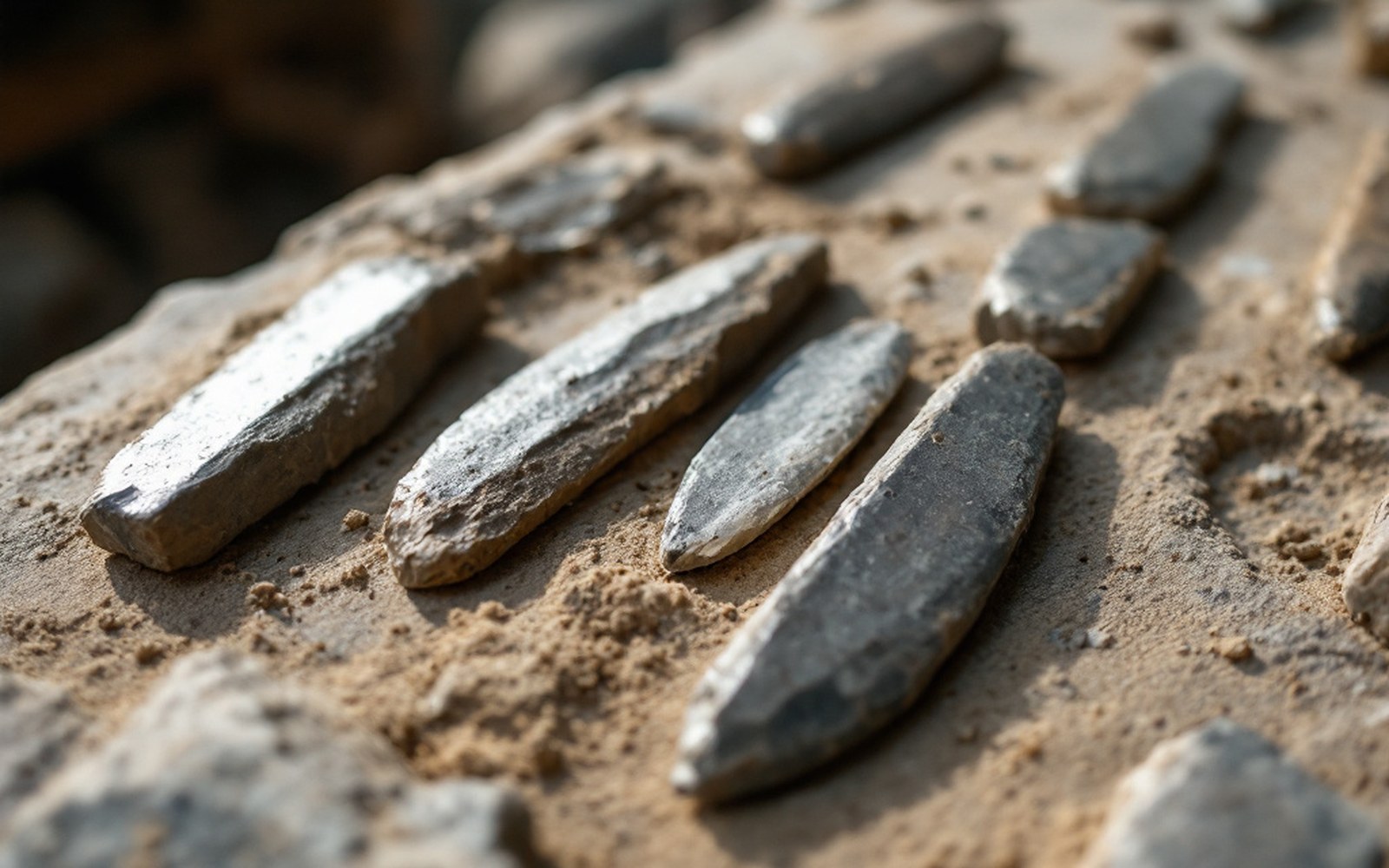
01The shift in what comes off the core
A blade, technically defined, is a flake at least twice as long as it is wide, with parallel or sub-parallel dorsal ridges running its length. That geometry does not happen by accident. It requires a prepared core shaped deliberately into a narrow-fronted, high-ridged volume before the first blade is struck — and a precise, often indirect percussion technique to drive a long, thin flake cleanly free without shattering it. The difference from earlier flake technologies is not just aesthetic. It is architectural: the core is a programme, and every blade removed reshapes the platform for the next.
Blade production appears in the Meuse basin assemblages broadly after 40,000 years ago, in layers that also carry personal ornaments, bone tools, and engraved objects — the package that European archaeologists group under the Upper Palaeolithic. At sites like Goyet, in Gesves, Namur, deep stratigraphy preserves the transition: Mousterian levels with their short, thick Levallois flakes underlie layers where long, regular blades and backed bladelets dominate. The sediment boundary is real, not an artefact of old digging.
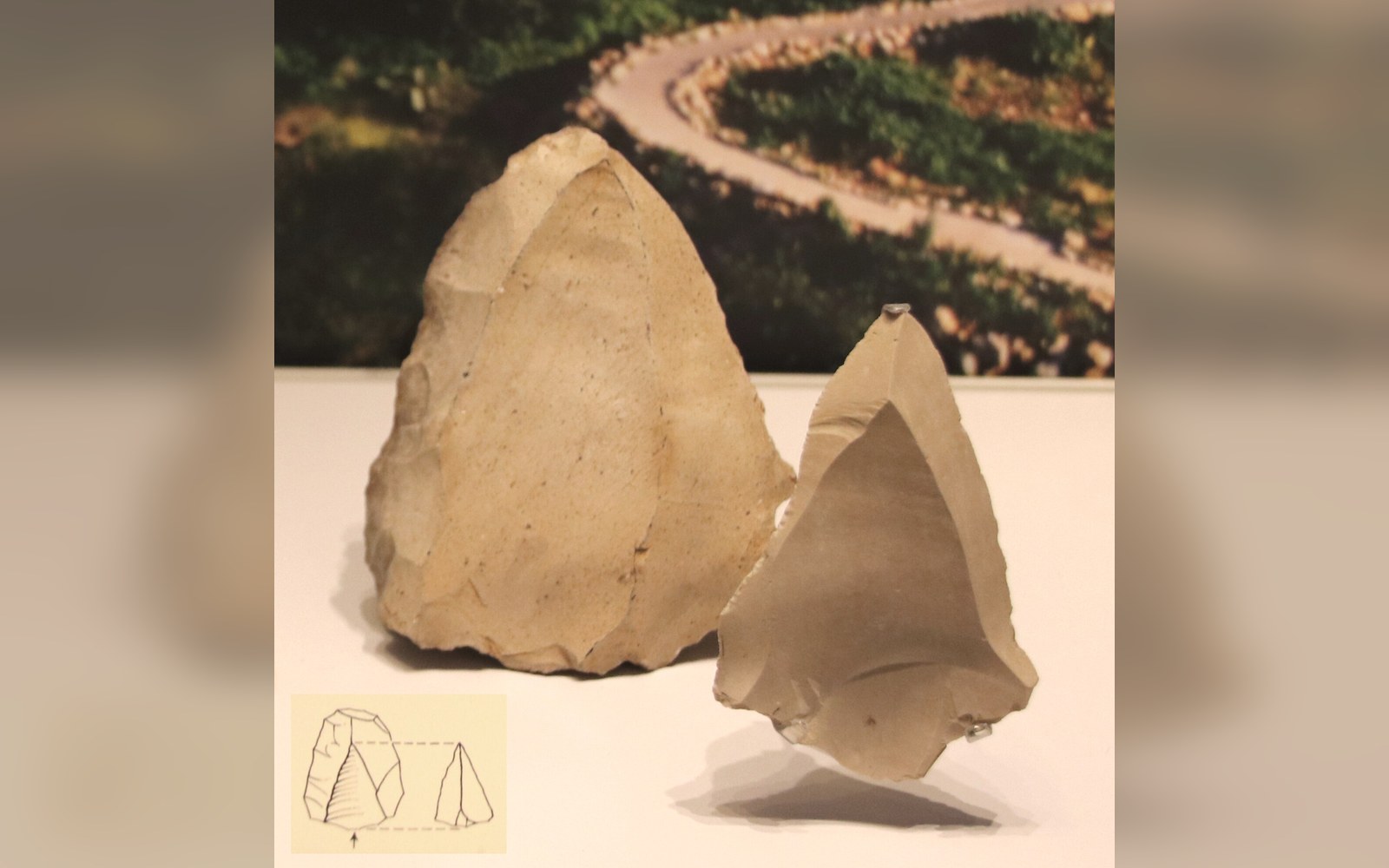
What the blade record establishes is a new reduction logic. Earlier knappers worked outward from a core, extracting usable flakes opportunistically. Blade knappers worked along a core, maintaining a crest — the carène, in French lithic terminology — that guided each successive removal. The toolmaker had to hold the whole sequence in mind before the first blow landed. Failure to maintain the ridge collapses the programme; you cannot recover a blade core the way you can rework a Levallois nodule.
The biological question sharpened as dating improved. Radiocarbon applied to fauna and charcoal from Belgian cave deposits through the 1990s and 2000s pushed the dates for the earliest blade horizons toward the period of Neanderthal disappearance in western Europe — roughly 40,000–42,000 years before present, uncalibrated. The Royal Belgian Institute of Natural Sciences ↗, whose collections include the Goyet faunal assemblages, holds material from these transitional layers. Direct AMS dating of human remains from Goyet, published in the 2010s, confirmed that anatomically modern humans ↗ were present there during exactly this window.
Chronology
- Blade-dominant assemblages in the Meuse basinbroadly post-40,000 BP (uncalibrated radiocarbon)
- Mousterian flake technologiespreceding, broadly 300,000–40,000 BP in western Europe
- AMS dating of Goyet human remainspublished 2010s, confirming modern human presence in blade layers
No blade assemblage in the Meuse basin has been reliably attributed to Neanderthals. The technology arrives with the people who replaced them.
Technical terms

Read next