Section VI · Dating · Entry 02
Revised Attributions
When the date changes, the object stays the same — it is only what we know about it that has been corrected.
Material dug in the nineteenth century has been reassigned more than once, which is an argument for keeping everything and labelling it well.

01The record is not finished when the trowel stops
Excavators in the nineteenth-century Meuse basin worked fast, kept variable records and assigned material to layers largely by eye. The assemblages they produced are not wrong so much as they are incomplete — and incomplete records turn out to be correctable, which is the point.
The Goyet caves, in Gesves, Namur, offer the clearest demonstration. Édouard Dupont cleared the site in the 1860s, assigning human bone fragments to what he read as Upper Palaeolithic layers. A century and a half later, direct radiocarbon dating of those fragments produced dates scattering across very different periods, including results placing certain human remains well into the Mesolithic. Some of the material Dupont had treated as a single occupation proved, on dating, to belong to entirely separate episodes separated by millennia. The bones were real, the layers were real, but the implied contemporaneity was not.
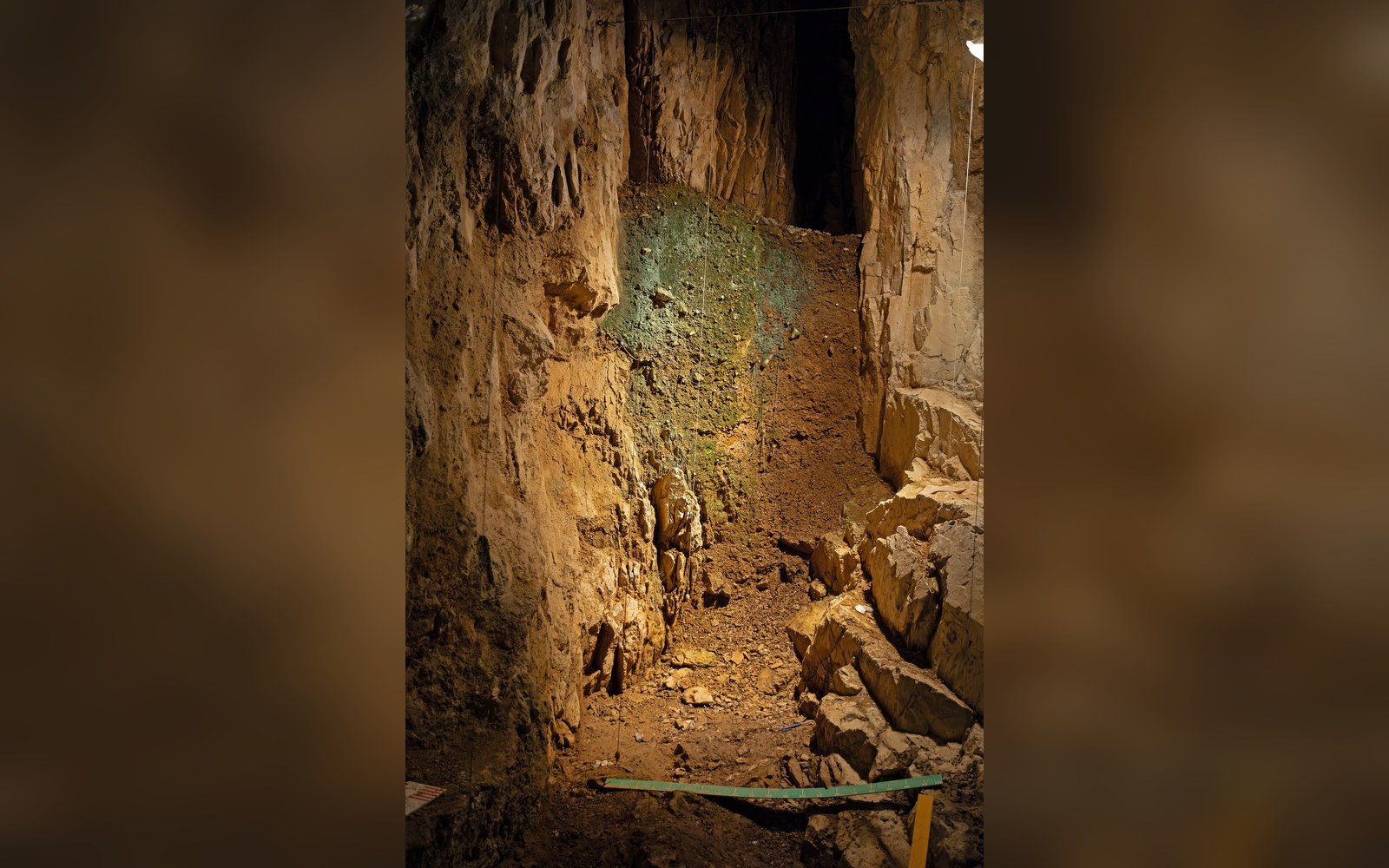
Spy, in Jemeppe-sur-Sambre, Namur, went the other way. Marcel De Puydt and Max Lohest recorded their 1886 excavation with unusual care, noting which layer each skeleton came from, and that stratigraphic rigour is precisely what allowed later researchers to work with the material at all. Direct radiocarbon dating of the Spy remains revised the age of the Neanderthal skeletons without invalidating the original association — it refined it. Good field records made the revision possible and meaningful rather than simply confusing.
At Engis, in Liège, the skull Philippe-Charles Schmerling ↗ recovered in 1829 from a breccia deposit took over a century to be recognised as Neanderthal at all, and the stratigraphic context Schmerling described in print — mixed with mammoth and rhinoceros — was not re-evaluated with modern methods until radiocarbon and uranium-series dating became available ↗. The revision here was taxonomic and chronological simultaneously: a different species, at a different date, than the nineteenth century had the tools to establish.
Chronology of revision
- 1829Schmerling recovers Engis skull; assigned to mixed fauna, species unrecognised
- 1860sDupont clears Goyet; human bone fragments grouped by inferred layer
- 1886De Puydt and Lohest excavate Spy with layer-by-layer records
- Post-1950Radiocarbon dating begins to produce direct dates on organic material
- 2000s onwardDirect dating of Goyet human bone reveals multi-period occupation; Spy skeletons re-dated without invalidating original stratigraphic context
The pattern across all three sites is similar: the principle that depth signals time was understood by the excavators, but without radiometric dates, relative stratigraphy could only go so far. What saves nineteenth-century material from being merely historical curiosity is curation — the Institut royal des Sciences naturelles de Belgique holds collections from all these sites, and physical retention of faunal and skeletal material has allowed each successive round of analytical methods to find something to test.
The argument for keeping everything and labelling it well is not sentiment. It is that the question you can ask of a specimen in 2025 was not a question in 1886, and the question asked in 2045 has not been formulated yet.
What makes a revision possible

Read next