Section I · The Caves · Entry 03
Goyet
A large cave system in the Gesves valley dug hard and fast in the 1860s, whose bones keep producing results that the original excavator never anticipated.
A large cave system dug from the 1860s whose material is still being re-examined with methods nobody then imagined.
01What Dupont Dug
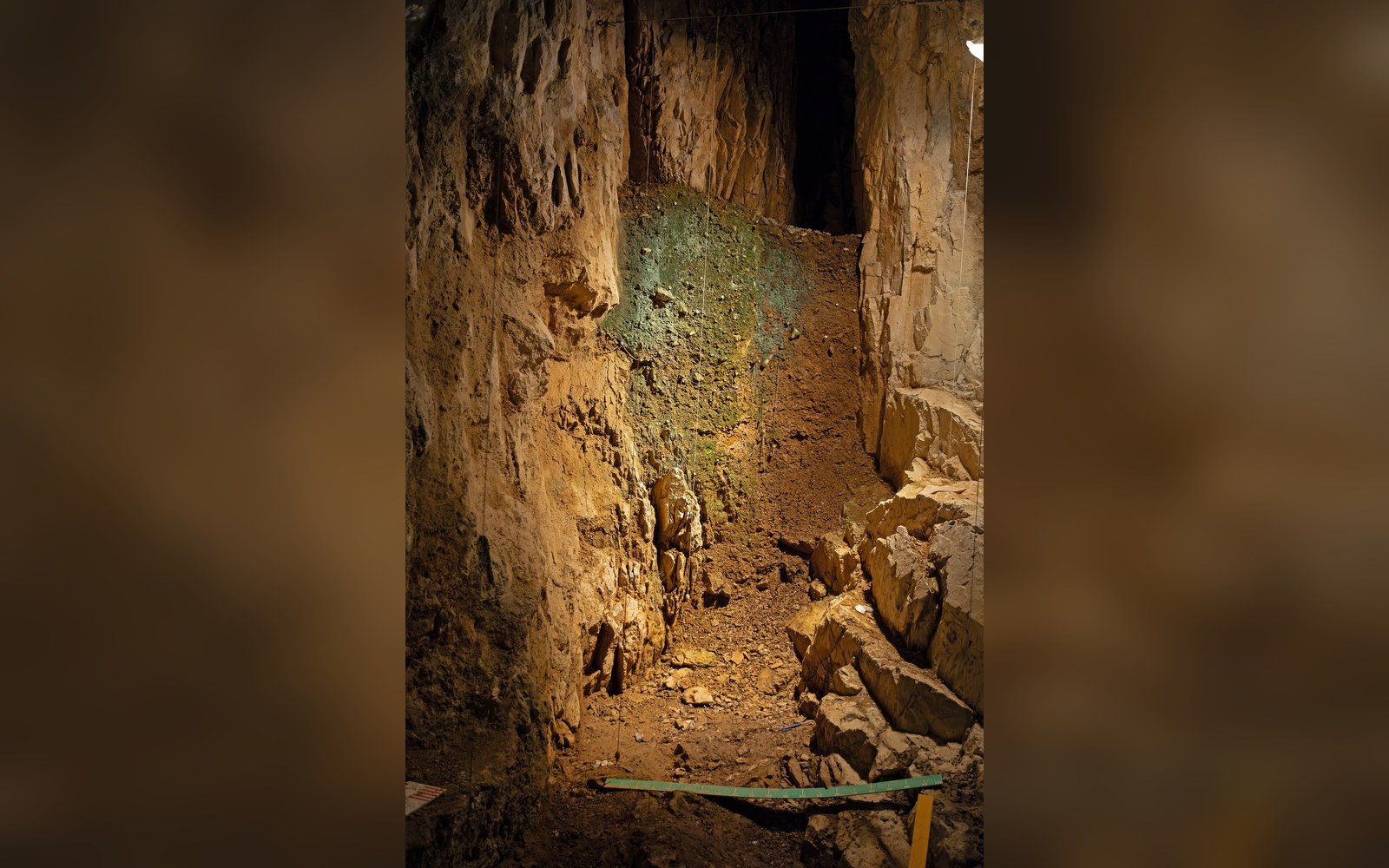
Goyet lies in the commune of Gesves, Namur province, where the Samson stream cuts through Carboniferous limestone before joining the Meuse. The cave system is not a single chamber but a complex of interconnected galleries on several levels, and that structural fact matters: sediment accumulated differently in each passage, which makes any attempt to read the stratigraphy across the whole site genuinely difficult.
Édouard Dupont dug Goyet in 1867 and 1868, working with the speed that characterised most of his Lesse and Meuse-tributary campaigns. He was then curator of the geology collections at what would become the Institut royal des Sciences naturelles de Belgique in Brussels, and he was assembling evidence for human antiquity across as many caves as possible in as short a time as possible. Goyet gave him plenty: fauna, flint, and human bone in substantial quantities, all extracted from a fill that included cave loam — the slow-accumulated matrix of washed-in sediment, decayed roof material and occupation debris that carries the finds — interbedded with harder deposits and collapse layers.
The flint assemblage Dupont recovered spans a long occupation history. Mousterian pieces — the characteristic Middle Palaeolithic technology associated with Neanderthals, with its prepared-core flaking strategies including Levallois reduction — appear in the deeper levels. Upper Palaeolithic material, including blade-based industries, occurs higher in the sequence. The stratigraphic separation that would make this confident was not, by later standards, adequately recorded; the sections were not drawn at the resolution that would let a twenty-first-century researcher know exactly which object came from which layer.
Key results from direct dating
02What the Bones Established Later
The human remains from Goyet sat in collections — principally at the Institut royal des Sciences naturelles de Belgique — for over a century before direct dating transformed what anyone could say about them. Radiocarbon applied to the actual bone collagen, rather than to associated finds or fauna, allows a specimen to be dated independently of where Dupont thought it sat in the sequence.
Results from campaigns of direct dating conducted in the early twenty-first century showed that Goyet holds some of the oldest anatomically modern human remains in northwestern Europe, with dates pushing back into the Aurignacian period — well over thirty thousand years before present. That finding placed the site in a different conversation from the one Dupont was having, which was primarily about demonstrating human coexistence with extinct fauna.
Upper Palaeolithic material, including blade-based industries, occurs higher in the sequence.
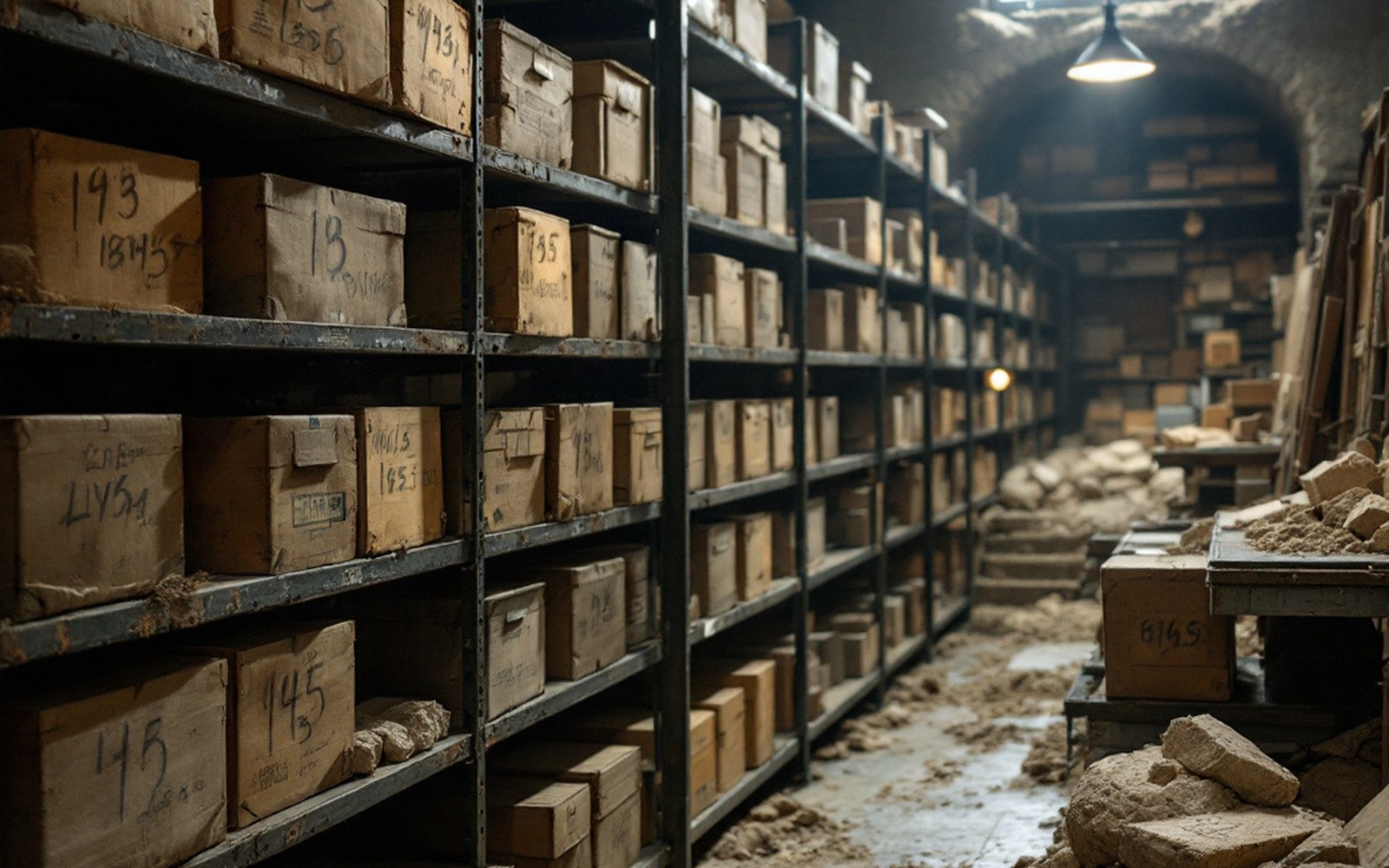
More striking still were the cut marks. Systematic re-examination of the Goyet human bone assemblage identified extensive butchery traces on human remains: cuts from stone tools, percussion marks from marrow extraction, and bone surfaces modified in ways consistent with processing for consumption. This evidence, published by Rougier and colleagues in 2016, proposed that some of the Goyet human remains had been processed in a manner associated with cannibalism. The human bones had also been worked into retouchers — tools used to sharpen flint edges — which placed human skeletal material inside the functional toolkit. None of this was visible to Dupont, and not only because the analytic methods did not exist: collection-level storage across 150 years meant the assemblage had to be reassembled from museum holdings before it could be read as a coherent body of evidence.
The fauna at Goyet includes reindeer, horse, cave bear, woolly rhinoceros and mammoth — the cold-climate assemblage typical of the Meuse basin during the Pleistocene glacial phases. These species constrain the environment and corroborate the broad chronological range that direct dating confirmed, though they cannot substitute for it.
What the bone surface analysis showed
Goyet is, in the end, a demonstration of what a nineteenth-century site can still yield when its collections survive intact and methods catch up with the material. Dupont's excavation was not negligible: he extracted enough bone in good enough condition that collagen survived for accelerator mass spectrometry dating ↗ more than a century and a half later. The site itself, at Gesves, remains a large and incompletely understood system — most of what can now be asked of it has to be asked of the collections, not the cave.

Read next