Section VI · Dating · Entry 01
Radiocarbon on the Spy Remains
Direct dating of material excavated in 1886 has repeatedly revised what the site is understood to show, including which finds belong together.

01What the bones were assumed to show, and why that was always a problem
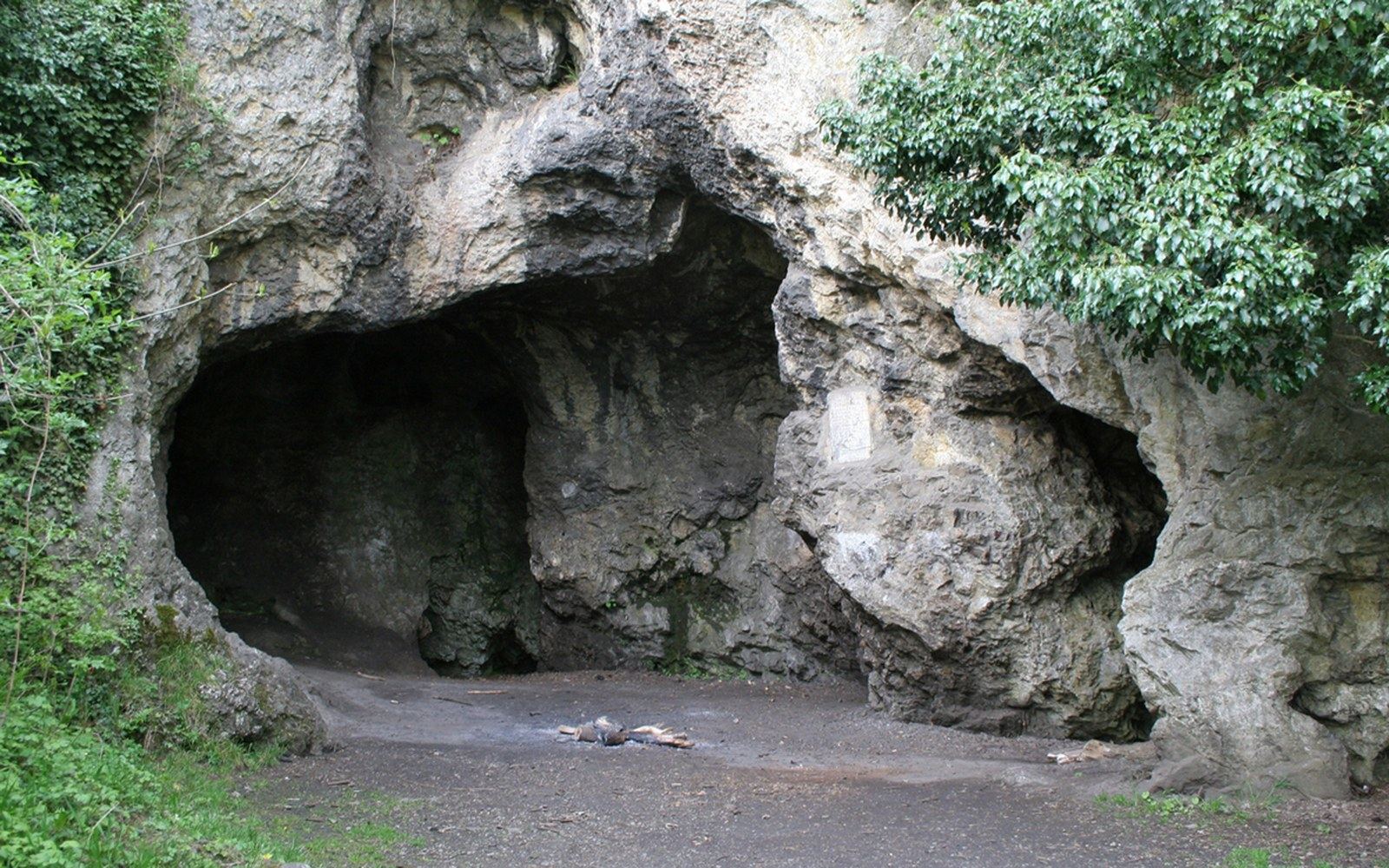
The two Neanderthal skeletons excavated at Spy, in Jemeppe-sur-Sambre, Namur, in 1886 came from a well-recorded context — well-recorded, at least, by the standards of the time. Marcel De Puydt and Max Lohest noted which layer each find came from, and Julien Fraipont described the anatomy in the joint publication that followed. For decades after, the site was treated as a clean association: Neanderthal skeletal material, Mousterian tools, and Pleistocene fauna, all from a single coherent deposit. The Neanderthals were old, the tools were theirs, and the fauna described the environment they lived in. Everyone agreed on the broad picture.
The problem was that no one had directly dated the bones. The age of the Spy individuals rested on the assumed age of the layer they came from, which rested in turn on the fauna and the tool typology. That is a reasonable inference, but it is an inference. The bones themselves had never been measured.
02What direct dating found, and found again
The first direct radiocarbon dates on Spy skeletal material established that the Neanderthal remains were genuinely old — consistent with a Middle Palaeolithic context and with what the stratigraphy implied. That much confirmed the general picture. But the campaigns that followed introduced complications.
Over successive decades, samples from the Spy collection held at the Institut royal des Sciences naturelles de Belgique ↗ in Brussels — the institution that has curated the material since the nineteenth century — were submitted to accelerator mass spectrometry (AMS) radiocarbon measurement. AMS requires only milligrams of collagen and can target a single skeletal element, which matters enormously when a collection has been assembled from material found across an excavation trench rather than from a single, isolated skeleton. Spy was not a single isolated skeleton. It was an accumulation of finds from a cave floor that had clearly seen repeated use.
Chronology of dating work
- 1886excavation by De Puydt and Lohest; age inferred from stratigraphy and fauna only
- Mid-twentieth centuryfirst radiocarbon dates on associated material; general Middle Palaeolithic age confirmed
- Early twenty-first centuryAMS direct dating of individual skeletal elements; some produce Upper Palaeolithic dates, prompting reassessment of which bones belong to which episode
- Ongoingcollagen quality assessment is now a precondition for accepting or rejecting individual dates
What the dating campaigns revealed is that not all of the material assigned to the "Spy Neanderthals" is the same age. Some elements dated consistently to the Middle Palaeolithic, as expected. Others produced dates that were substantially younger — falling into the Upper Palaeolithic — suggesting that either those elements were intrusive, came from a different depositional episode, or were mixed into the assemblage during excavation. The 1886 dig, however careful by its era's standards, moved through sediment quickly and could not have detected fine-grained stratigraphic differences that would be apparent to a modern excavator working with a trowel and a sieve.
What the dating campaigns revealed is that not all of the material assigned to the "Spy Neanderthals" is the same age.
03The problem of association and what it costs the record
The dating results forced a direct re-examination of a question the 1886 excavators never had to ask: which bones actually belong together, and which Neanderthal do they belong to? When De Puydt and Lohest designated "Spy I" and "Spy II," they were working from anatomical position and proximity in the deposit, not from any means of confirming contemporaneity. Two bodies in the same layer is a reasonable grouping, but radiocarbon can test whether two elements assigned to the same individual were even deposited in the same millennium.
Researchers working on the Spy collection in the early twenty-first century — collaborations involving the Institut royal des Sciences naturelles and several university laboratories — found that the collagen preservation in some elements was poor enough to compromise dating reliability, adding another layer of uncertainty. Collagen survival in Pleistocene bone ↗ depends on temperature history, soil chemistry and depositional conditions; a Belgian cave that was accessible to surface drainage and periodic flooding, as Spy was, is not ideal preservation territory for material approaching fifty thousand years in age. Dates on degraded collagen can be skewed toward the present, making genuinely old specimens appear younger. This means some of the anomalously young dates from Spy material may reflect contamination or collagen degradation rather than genuine younger deposition.
Direct dating means measuring the radiocarbon in collagen extracted from the bone itself, rather than inferring its age from the sediment or the artefacts found nearby. Each result therefore applies to one specific element, which is why the assignment of bones to individuals can now be tested. A date is only as reliable as the collagen behind it, however.
The implication is uncomfortable: the record for Spy, which was already acknowledged as a nineteenth-century excavation with all the limits that entails, is less tidy than even its defenders claimed. Some elements now have well-constrained direct dates; others remain uncertain because the collagen is too degraded to produce a reliable result. A few have been excluded from analysis altogether.

04What stays standing
None of this dismantles what Spy established in 1886. The core finding — that anatomically Neanderthal skeletal material was found in secure stratigraphic association with Mousterian tools — was recognised as significant precisely because De Puydt and Lohest recorded which layer their finds came from, a discipline that set Spy apart from earlier Belgian cave excavations. That record is what made the collection worth dating at all: there was a documented stratigraphic context to test.
What the dating campaigns have revised is the detail. The Spy Neanderthals are no longer treated as a single unproblematic assemblage from a single moment in time. Specific elements have specific dates; others remain ambiguous. The fauna recovered alongside the skeletons — reindeer, woolly rhinoceros, mammoth — describes a cold-stage environment consistent with late Middle Palaeolithic occupation, and the dated Neanderthal elements that do yield reliable collagen are consistent with that picture. The faunal association has not been overturned.
Some elements dated consistently to the Middle Palaeolithic, as expected.
What has changed is the confidence with which researchers can speak about particular bones. Any argument that rests on a specific element of the Spy collection — its morphology, its pathology, what it implies about Neanderthal behaviour or biology — now needs to account for whether that element has a reliable direct date, and what that date is. This is not a failure of the site; it is what happens when a nineteenth-century collection meets twenty-first-century analytical standards. The question becomes not "is Spy reliable?" but "which parts of Spy, specifically, and how do we know?"
Direct dating has made the collection simultaneously more useful and more complicated. More useful, because specific elements now carry real ages rather than inferred ones. More complicated, because the clean association everyone assumed for a century has turned out to be a more layered, stratigraphically intricate record than a cave floor dug in a matter of days could ever have fully resolved.
Read next