Section IV · The Finds · Entry 01
The First Neanderthal
A skull excavated in 1829, a species named in 1864: the gap between finding and understanding is itself the history
Excavated in 1829 and not recognised for a century — the record shows the evidence arriving long before anyone had a category to put it in.

01When the evidence outran the theory
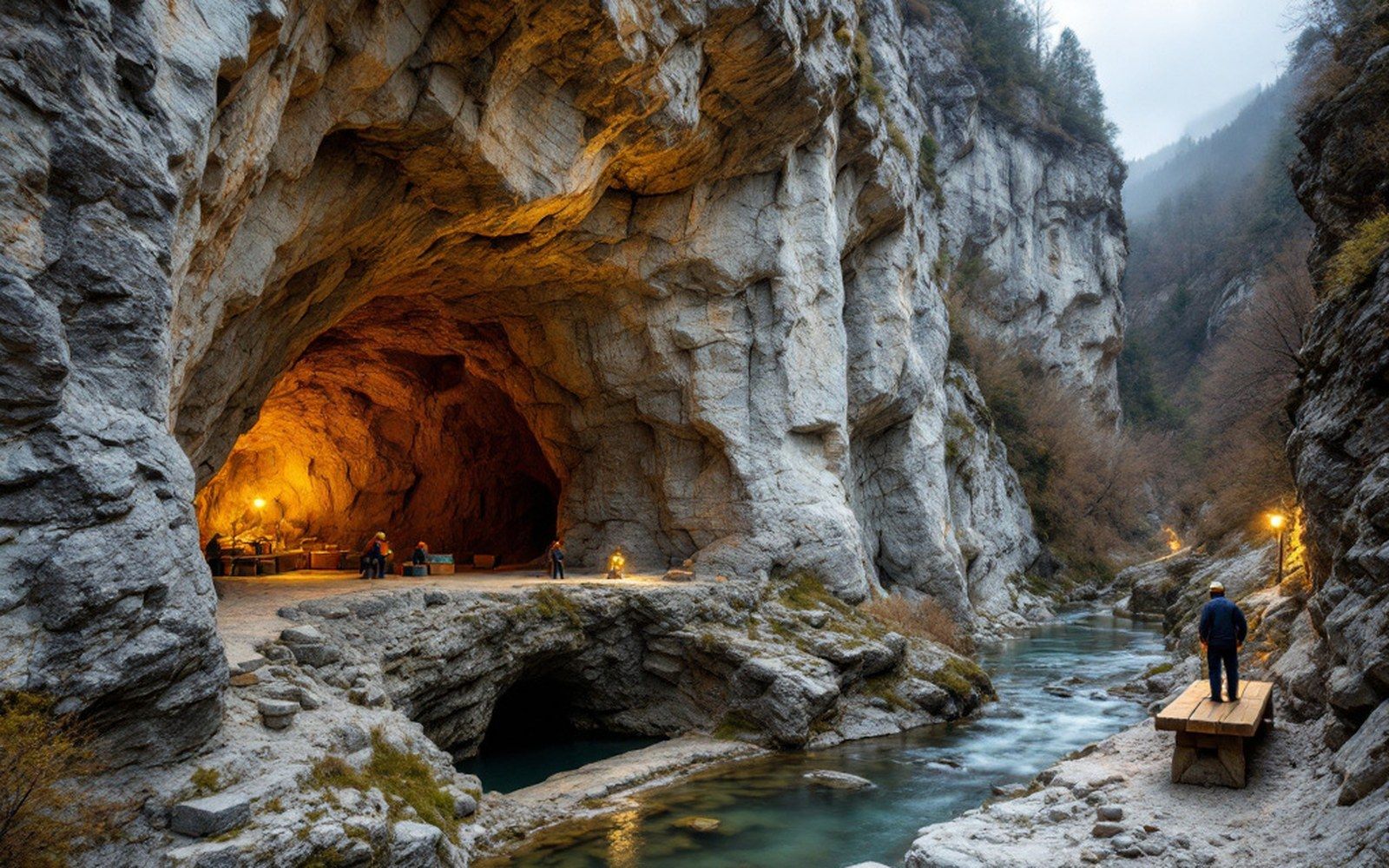
The cave at Engis, in the commune of Engis, Liège province, sits above the Meuse where the valley narrows between limestone bluffs. In 1829, Philippe-Charles Schmerling climbed to it — as he climbed to dozens of Meuse valley caves in those years — and dug. What he extracted from the breccia included rhinoceros, cave bear and mammoth bone, Palaeolithic flint tools, and the cranium of a child. He published it all in 1833 in Recherches sur les ossements fossiles découverts dans les cavernes de la province de Liège, a two-volume work illustrated with his own drawings. He called the human remains ancient. Almost nobody believed him.
The difficulty was not the skull itself. It was the framework. In 1829 there was no established concept of prehistoric humanity, no accepted deep chronology for the human species, and no methodological standard against which Schmerling's stratigraphy could be evaluated. His argument — that the child's skull lay in undisturbed deposits alongside extinct animals — was dismissed on the grounds that such an association was inherently improbable. The geology was right; the theory to receive it had not yet been constructed.
Schmerling died in 1836. The skull sat in collections at the University of Liège ↗, labelled, catalogued, unresolved.
Chronology of recognition
- 1829Schmerling excavates Engis cave, recovers Engis 2 cranium
- 1833Publication of Recherches sur les ossements fossiles; contemporaneity of human and faunal remains argued, largely rejected
- 1836Schmerling dies; skull remains in University of Liège collections
- 1856Feldhofer Neanderthal excavated in Germany; becomes the type specimen and gives the species its name
- 1863Huxley examines Engis 2; identifies it as archaic, consistent with the Neanderthal type
- 1886Spy skeletons define Neanderthal morphology in detail; Engis 2 attribution strengthened retrospectively
02What the skull actually is
The Engis 2 cranium — as it is formally designated — is the preserved braincase of a young child, probably three to four years old at death. It is Neanderthal. The morphological case for that attribution was not made until Thomas Henry Huxley examined it in 1863 and noted its archaic features. By then, the Feldhofer Neanderthal from the Neander valley in Germany — excavated in 1856 — had supplied the name and the type specimen, and Huxley was working backward through the existing collections to see what else qualified. Engis 2 qualified.
The implications are precise: Schmerling had the first Neanderthal fossil ever recovered by a named excavator in a documented context ↗, and had it thirty-five years before anyone had a name for it. That is not a footnote; it is a lesson in how evidence and interpretation travel at different speeds.
That is not a footnote; it is a lesson in how evidence and interpretation travel at different speeds.
There is a second human skull from Engis — Engis 1 — which is anatomically modern. Schmerling had both, in what appeared to be the same deposit. This caused decades of confusion about which specimen was which, which deposit was primary and whether the association meant anything at all. The confusion was productive: it forced later workers to be more precise about what stratigraphic association actually proves.
What the deposit established
03The question of the layer
Schmerling's stratigraphic practice was better than his critics allowed but worse than it needed to be to settle the argument definitively. He recorded which chamber material came from, he noted depth below surface, and he observed that the human and animal bones were cemented together in the same matrix — cave breccia, the hardened accumulation of sediment, bone and carbonate that fills cave floors and walls over millennia. What he could not demonstrate, to the satisfaction of sceptics, was that no later burial or intrusion had mixed the deposits. The layer was his evidence; the layer's integrity was precisely what was in dispute.
This is the methodological trap that plagued nineteenth-century cave excavation across the Meuse basin. Depth is time only if the deposit is undisturbed, and establishing that disturbance has not occurred requires the kind of section drawing and spatial recording that became standard only later in the century — and was not itself universal until the twentieth. Schmerling's notebooks and drawings show him thinking stratigraphically, but they do not provide the documented, layer-by-layer, spatially referenced record that would have been unassailable. His conclusions were sound; his documentation could not defend them against determined doubt.
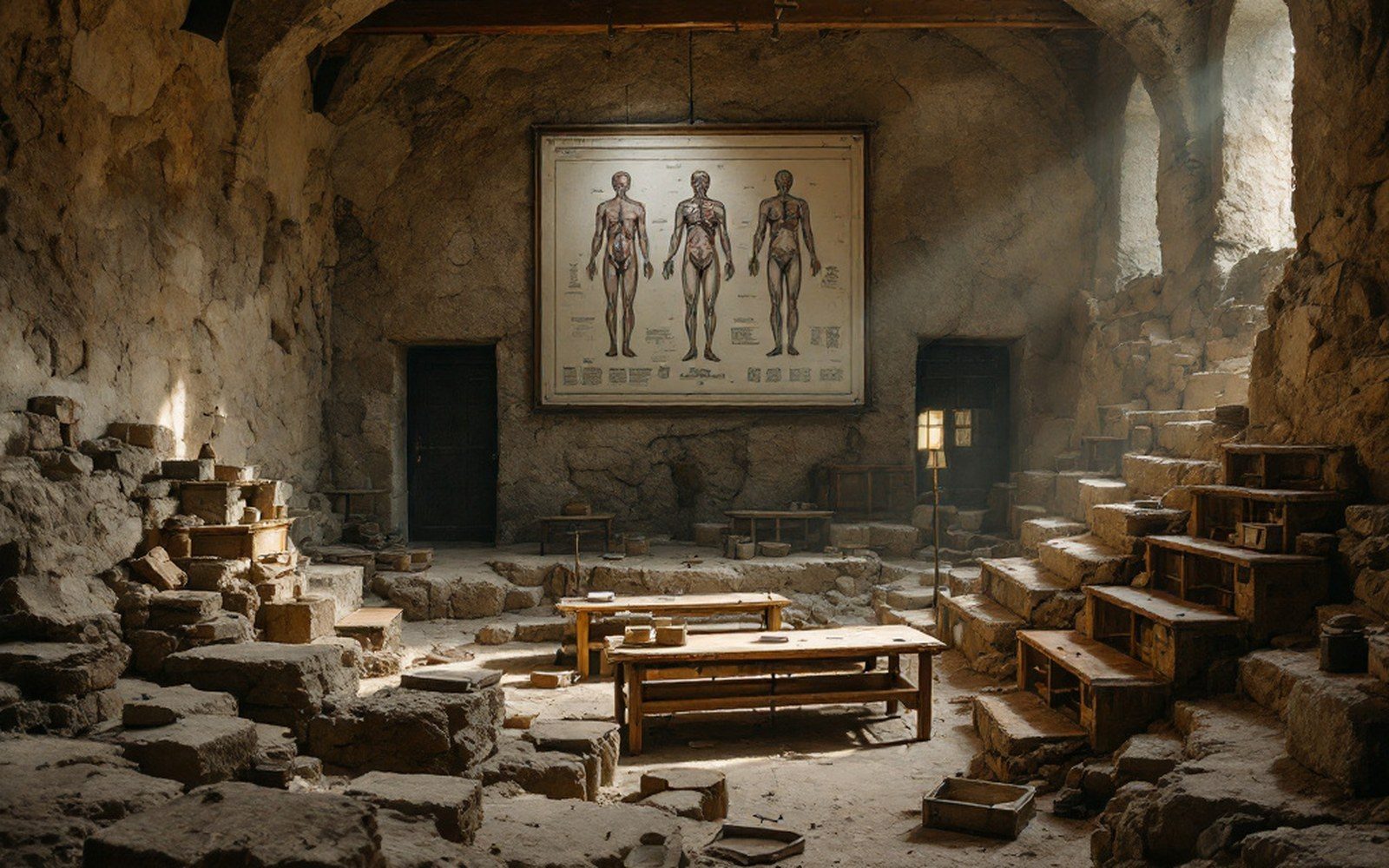
The scepticism was not entirely unreasonable. Cave sediments are complex: roof falls reopen floors, animals burrow through deposits, and human groups return to the same spaces across tens of thousands of years. A skull in breccia alongside mammoth bone is strong circumstantial evidence of contemporaneity, but circumstantial is the operative word. It took the convergence of stratigraphy, anatomy and eventually chemistry to make the case.
There is a second human skull from Engis — Engis 1 — which is anatomically modern.
04How the record closed
The anatomical case was made incrementally — Huxley in 1863, then the recovery of complete Neanderthal skeletons at Spy, in the commune of Jemeppe-sur-Sambre in 1886, which gave anatomists enough material to define the morphology properly. Once the Spy skeletons were described by Julien Fraipont and established the Neanderthal body plan in detail, Engis 2 could be placed within it with confidence. A child's cranium preserves fewer diagnostic features than an adult, but it preserves enough: the characteristic brow ridge development, vault shape and occipital profile are visible even in an immature specimen.
The chemical and radiometric case came later still. Direct radiocarbon dating of Neanderthal material became possible in the 1980s and was progressively refined through the 1990s and 2000s as methods moved from conventional to AMS — accelerator mass spectrometry — and sample pretreatment improved. Dating the Engis 2 cranium is complicated by the fact that it was handled extensively in the nineteenth century, potentially contaminated, and that young bone loses collagen faster than adult bone. Dating of the associated fauna and of other Neanderthal assemblages in the region provides the chronological bracket: Middle Palaeolithic Neanderthal occupation in the Meuse basin falls broadly between 130,000 and 40,000 years ago ↗, with the later end constrained by radiocarbon and the earlier end by luminescence dating of cave sediments.
What the Engis record establishes, when read in full, is not just that Neanderthals were present in the Meuse valley but that the evidence for it was sitting in a published scientific work in 1833. The history of paleoanthropology is often told as a story of discovery; it is equally a story of recognition — of knowing what you are looking at. Schmerling looked at the Engis child's skull and saw an ancient human. He was right. It took the discipline roughly a century to catch up with him.
Read next