Section IV · The Finds · Entry 02
Fauna and Environment
The animal bones from a Palaeolithic layer often tell you more about the climate than anything the toolmaker left behind.
Reindeer, horse and mammoth in the same deposits describe a climate, which is often the most useful thing a layer contains.
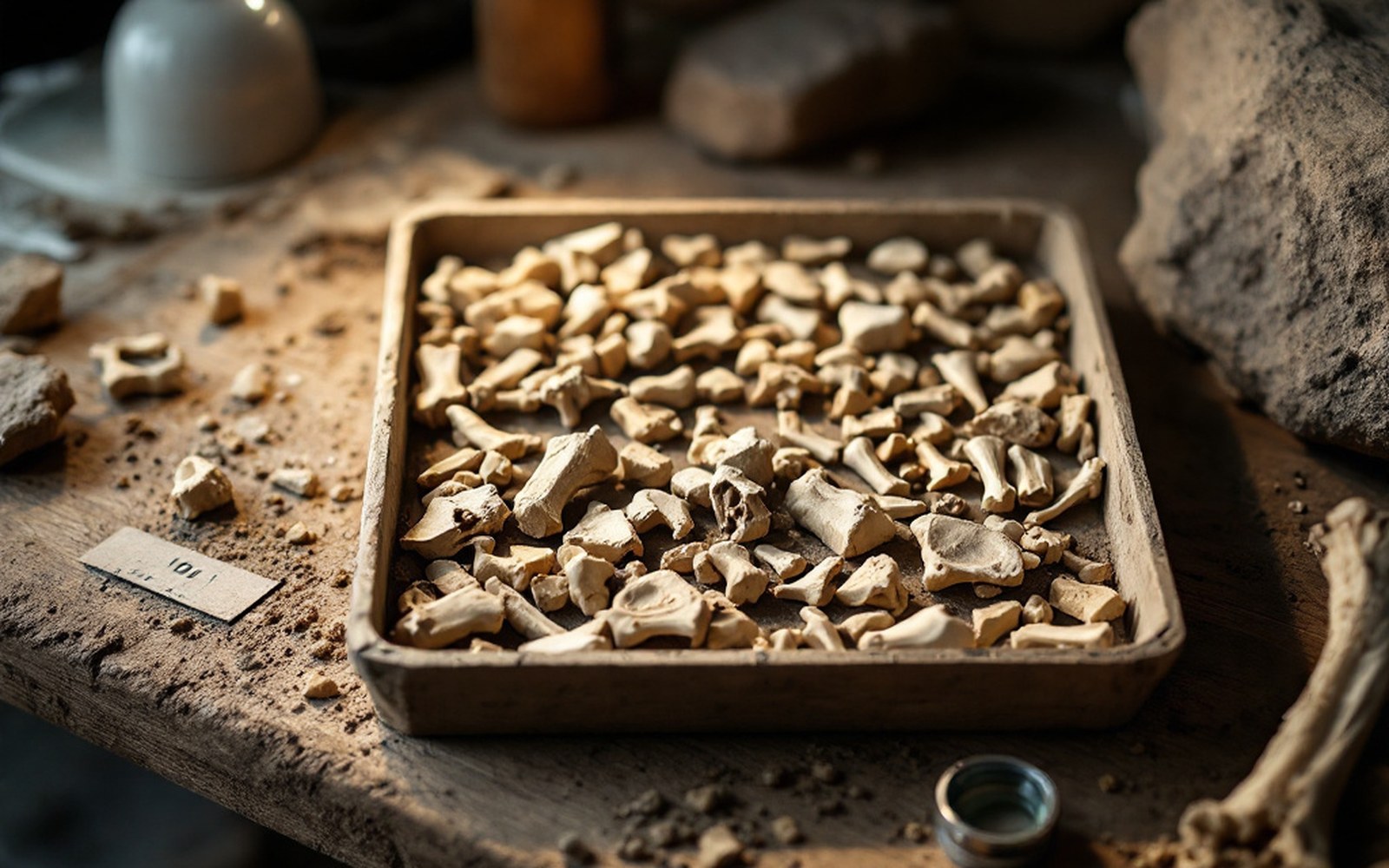
01What the bones record
Reindeer, horse, woolly mammoth, woolly rhinoceros, cave bear — these are not incidental finds. Their presence in the same deposit defines a climate zone and, given that each species has a reasonably well-understood ecological range, a season or a season's end. When Édouard Dupont cleared the Lesse valley caves in the 1860s at sites such as Chaleux and Goyet, he pulled animal bone out in quantity alongside the flint. The species list he recovered — dominated by reindeer and horse in the upper Palaeolithic layers — pointed unambiguously to a cold, open steppe-tundra environment: the landscape that modern radiocarbon work has since confirmed as the Last Glacial Maximum and the millennia bracketing it.
The key is association: a bone only argues for climate if it comes from a securely recorded layer, because cave fill accumulates from multiple episodes and burrowing animals mix what time deposited separately. This is why the difference between Dupont's speed and the controlled excavation of a site like Trou Al'Wesse matters so much — a species list with no stratigraphic provenance is merely a census, not an environmental sequence. Where the stratigraphy holds, reindeer-dominant assemblages typically map onto cold phases, while red deer and aurochs signal the warmer intervals between them.
Mammoth presents a separate problem. Mammoth bone survives well and was sometimes carried into caves by humans rather than dying there, which means a single element can travel far from where the animal lived or was killed. At Goyet, recent zooarchaeological analysis of the cave's extensive faunal material ↗ has demonstrated deliberate bone processing — cut marks, percussion damage — that shifts the interpretive weight from environment to human behaviour, without cancelling the palaeoclimatic signal entirely.
Fish bone and bird bone, when recovered with fine-sieve techniques, sharpen the picture further: certain salmonids and cold-adapted ptarmigan appear in the same cold-phase deposits as reindeer, cross-checking the mammal record. Older excavations rarely sieved at all, so the small-fauna record for most nineteenth-century Belgian sites is essentially missing.
What the key species signal
The fauna, in short, is a thermometer ↗ — one that only reads correctly when the layer it came from was recorded before it was emptied.

Read next