Section III · The Flint · Entry 01
The Levallois Core
The core is shaped first and the flake is struck last, which means the toolmaker had the finished shape in mind before the first blow.
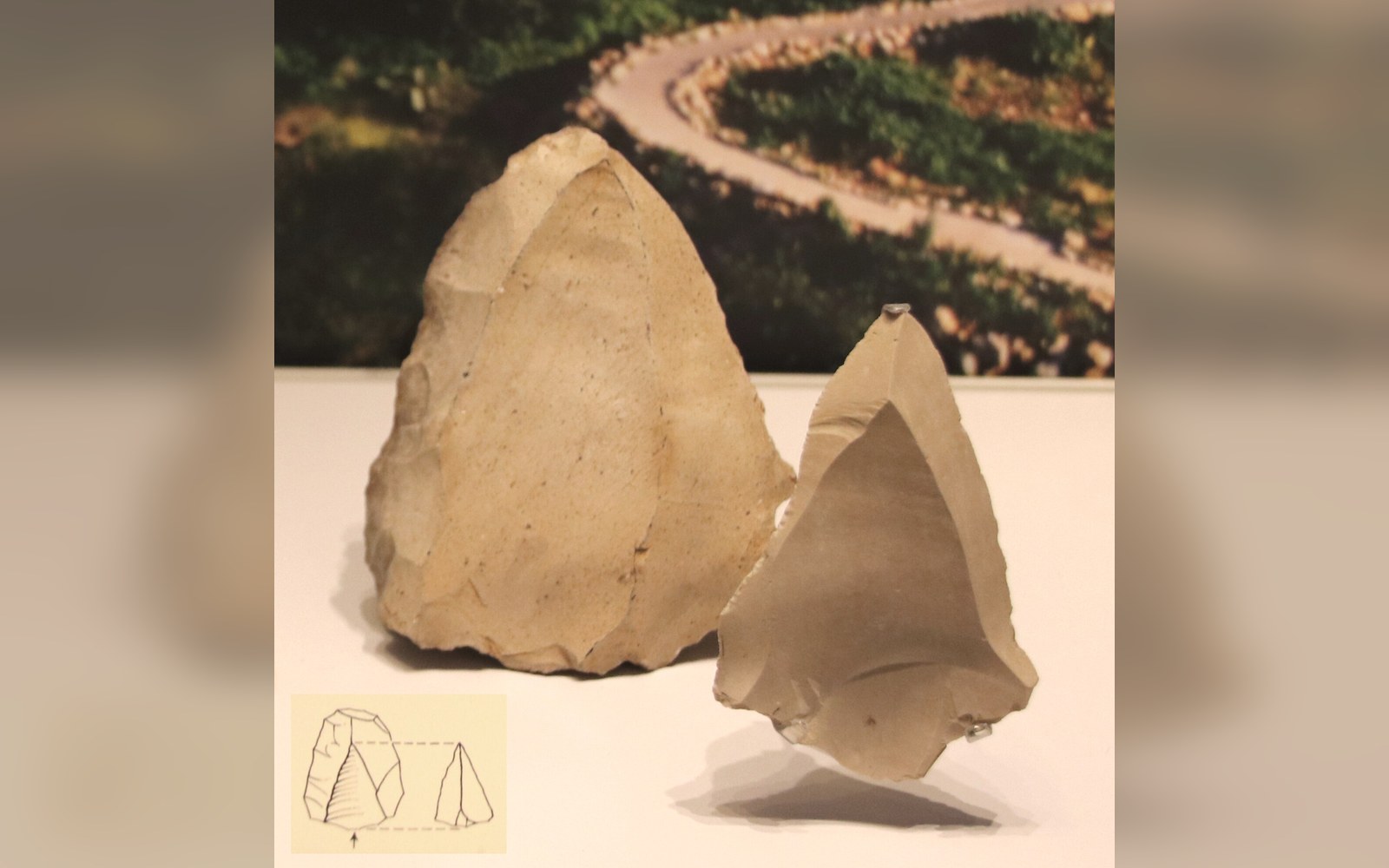
01Prepared in advance: how a toolmaker built the shape into the stone
The flake comes off last, but the work begins long before it. That is the central fact of Levallois technology, and it is what separates a prepared-core flake from the debitage — the waste — of any simpler reduction. By the time the toolmaker strikes the final blow, the flake's shape, thickness and edge profile are already determined. The core is the mould; the flake is the casting.
Understanding this took time. For decades after nineteenth-century excavators began recovering Levallois flakes from Belgian cave deposits, the objects were catalogued by what they looked like — flat-faced, oval, with a distinctive faceted striking platform — without a clear account of how they were made. It was the systematic study of the cores themselves, and of the waste flakes generated at each preparatory stage, that revealed the sequence. Reading an assemblage backwards, from finished flake to exhausted core, is now standard practice; it was not always.
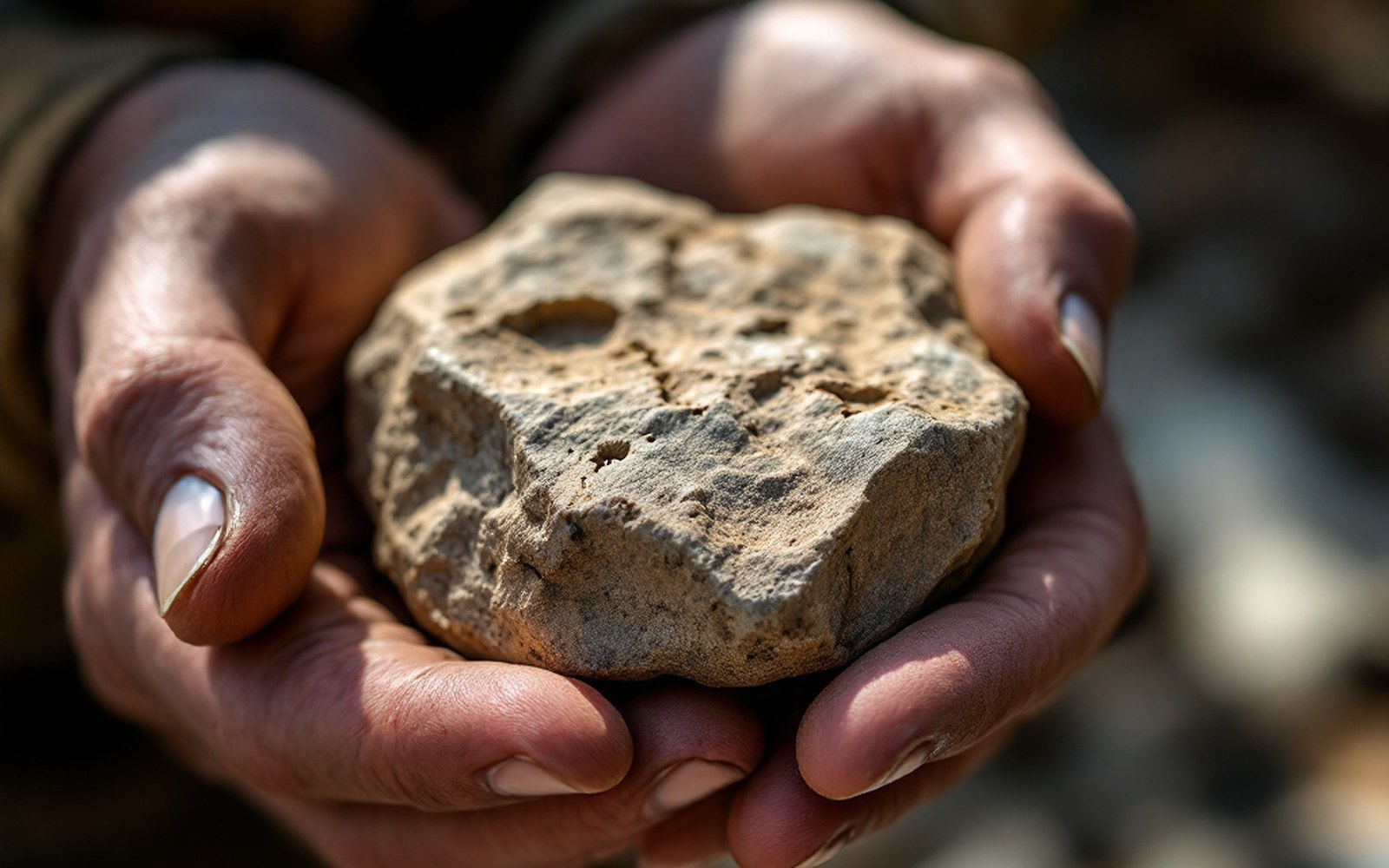
02Shaping the volume
A Levallois core starts as a nodule — a lump of flint, ideally with a cortex (the weathered outer rind) that the knapper can use to judge the stone's internal quality. The first task is not to produce useful flakes but to build a specific geometry. The knapper removes a series of flakes around the perimeter of the nodule, working centripetally — inward from the edges toward the centre — across what will become the dorsal face of the eventual Levallois flake. These removals are not the product; they are the preparation. Each one flattens and shapes the upper surface, creating a domed or tortoise-shell profile that, when the core is turned over, concentrates force in a predictable way.
The underside of the core — the ventral face — is kept relatively flat throughout, because it will provide the platform surface. At the end of preparation, the knapper shapes a striking platform at one end: a small, carefully faceted surface set at the right angle to direct the percussive wave across the prepared face and detach the predetermined flake cleanly. This faceting of the platform is one of the most diagnostic features in the archaeological record. When you find a Levallois flake, the multiple small facets visible at its proximal end — the end nearest the old platform — are the direct imprint of that preparatory work.
Reduction sequence — key stages
- Nodule selectionchoose flint with sound interior, inspect cortex
- Dorsal preparationcentripetal removals shape the upper face into a dome
- Platform preparationfaceting creates the angle for the final blow
- Predetermined removalthe Levallois flake detaches; shape was fixed before the blow
- Core exhaustiondepleted cores are sometimes reworked or discarded at the knapping spot
The sequence demands forward planning across at least three distinct operations: shaping the dorsal face, preparing the platform, then executing the final removal. That final blow, if everything has gone correctly, produces a flake whose outline, cross-section and edge angles were fixed by the preceding work. The scar patterns left on the dorsal face record every prior removal; an experienced analyst can read the whole sequence from a single finished flake.
The underside of the core — the ventral face — is kept relatively flat throughout, because it will provide the platform surface.
03What the record shows
Levallois technology is characteristic of the Mousterian, the Middle Palaeolithic industrial complex associated throughout western Europe with Neanderthal populations from roughly 300,000 to 30,000 years ago. It appears across a vast geographic range — from the Atlantic coast to Central Asia — but it is not universal within the Mousterian: different sites and different time periods show it in varying proportions, combined or replaced by other core-reduction strategies. That variability is itself informative, and it has driven decades of debate about whether different Mousterian facies represent different human groups, different tasks, different raw materials or simply different stages of the same reduction sequence.
In the Meuse and Lesse valley caves, Édouard Dupont recovered Mousterian assemblages from a succession of sites during the 1860s and 1870s — Goyet in the commune of Gesves, Chaleux, sites along the Lesse — working at a pace that recovered quantities of material but left stratigraphic detail thin by later standards. The Levallois pieces among his collections can be identified typologically, but reconstructing the exact depositional context many of them came from is difficult. Later work at sites such as Trou Al'Wesse in Modave ↗, where modern excavation methods have been applied to Middle Palaeolithic deposits, provides the kind of spatial and stratigraphic resolution that allows real reduction-sequence analysis: refitting — physically rejoining flakes to cores or to each other — can reconstruct the knapping event and sometimes locate where in the cave the different stages happened.
Terms worth setting apart
Refitting is the most direct test of whether an assemblage is in primary context, meaning the material lies where it fell, or has been moved by water, animal activity or earlier digging. A Levallois core and the flakes removed during its preparation, if they refit, could only have been moved apart from each other after the knapping stopped — and the distance between refitting pieces tells you how far and in what direction. At Goyet, whose deposits span a long stratigraphic sequence and whose material has been subject to ongoing re-examination, refitting work has clarified which assemblage elements belong together and which are residual from different occupations mixed by post-depositional processes.

04The shape of the knowledge
What does a Levallois core actually establish? Several things at once. It demonstrates a reduction strategy that is cognitively demanding in a specific way ↗: the toolmaker must represent the finished product before it exists and must execute a multi-stage sequence in the right order, adapting to how the stone behaves at each step without losing the intended end-point. The cores and their preparation flakes together constitute a record of that process, legible to anyone trained to read it.
Dating the assemblages that contain Levallois material has shifted as methods have improved. Early associations between Mousterian layers and large Pleistocene fauna gave relative dates; radiocarbon dating provided absolute dates but is limited to material younger than roughly 50,000 years, which cuts out much of the Mousterian entirely. Uranium-series dating and optically stimulated luminescence (OSL) have extended the range, and direct dating of faunal remains from stratified Mousterian contexts has revised several Belgian site chronologies upward — older than previously thought, and sometimes beyond the reach of radiocarbon altogether.
This faceting of the platform is one of the most diagnostic features in the archaeological record.
The core survives when the flake has long since been lost, used up and discarded elsewhere. It is the evidence that planning happened: not the product of the technology, but the proof of it. That is why the core, not the flake, is the more informative object — and why an assemblage counts exhausted cores as carefully as finished tools.
Read next