Section I · The Caves · Entry 02
Spy
The 1886 excavation produced skeletons that settled the argument, and it did so because the excavators recorded which layer they came from.
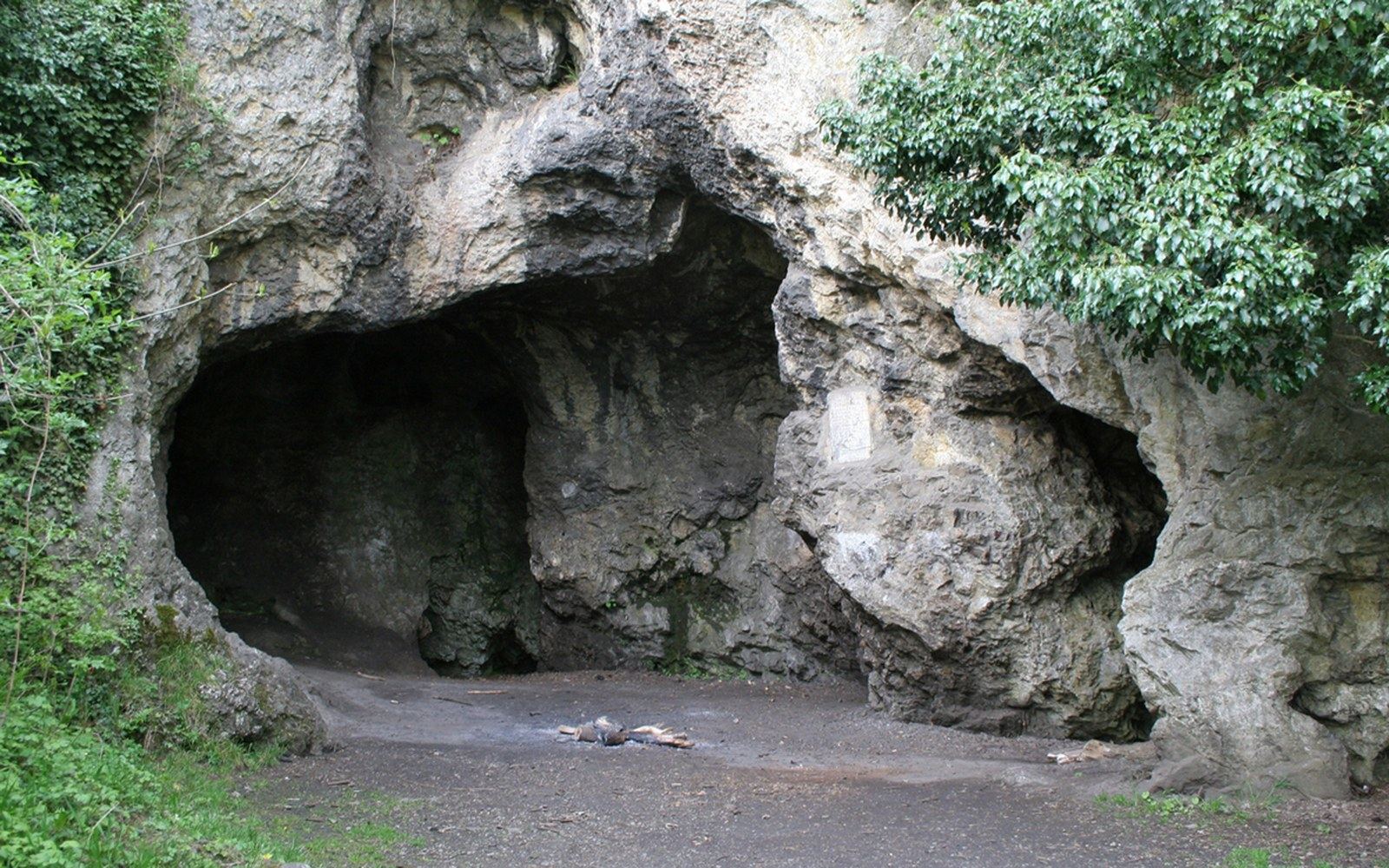
01Two skeletons from a known layer settled the Neanderthal question
The cave at Spy sits above the right bank of the Orneau, a small tributary of the Sambre, in what is now the commune of Jemeppe-sur-Sambre, Namur province. In August 1886 Marcel De Puydt and Max Lohest opened a trench across the cave floor and, within weeks, recovered two partial human skeletons along with a substantial flint assemblage and the bones of extinct animals. What made those weeks count for more than the previous half-century of cave digging was simple: they wrote down exactly which layer each find came from.

02The site and its deposits
The cave — properly the grotte de Spy, occasionally transcribed as Betche-aux-Roches — opens in a limestone cliff at roughly the point where the valley narrows. The deposits excavated in 1886 occupied a terrace in front of the cave mouth rather than the deep interior, and they were arranged in readable horizontal bands. From the surface downward: a humic zone of modern disturbance, then a layer of cave loam carrying Iron Age and Gallo-Roman intrusions, then a clay-and-stalagmite band that served as a natural seal, and beneath that the Palaeolithic horizon — a grey-brown silty deposit resting on fractured limestone floor. The human remains and the Mousterian flint industry came from this lowest unit, in direct association with reindeer, woolly rhinoceros, mammoth, and cave bear. Association of this kind — anatomically modern-looking bones beside undeniable Palaeolithic fauna — had been claimed before, and had always been challenged on the grounds that the finder could not prove the bones had not sunk from above. De Puydt and Lohest removed that objection by keeping a written and drawn record as they went.
Julien Fraipont ↗, professor of palaeontology at the University of Liège, took charge of the anatomical description. His analysis, published jointly with Lohest in 1887, established that the two individuals — an adult of indeterminate sex and a second adult, both fragmentary — shared a cluster of features that matched the Feldhofer skeleton found in the Neander valley in 1856 and the Engis skull that Philippe-Charles Schmerling had dug out of the cave above the Meuse in 1829 without anyone understanding what he had. The brow ridges were heavy, the braincases long and low, the occipital bones projecting at the rear. Fraipont named the type Homo neanderthalensis, making explicit what the Feldhofer find had implied: this was not a diseased modern, not a Cossack, not a developmental anomaly, but a genuinely archaic form of human being whose remains now came from two countries and three separate caves, all stratified into Palaeolithic sediments alongside Palaeolithic animals and Palaeolithic tools.
Chronology
- 1829Schmerling recovers the Engis skull; its significance is not understood for decades
- 1856Feldhofer skeleton found in the Neander valley, Germany; debate begins about its nature
- August 1886De Puydt and Lohest excavate Spy; two skeletons recovered in stratified context
- 1887Fraipont and Lohest publish the anatomical description; Homo neanderthalensis formalised
- Mid-to-late 20th centurydirect radiocarbon dating places the Spy individuals at approximately 36,000–40,000 BP
- Ongoingancient DNA and morphometric studies use the Brussels collections
03The flint industry and what it meant
The stone tools recovered from the Palaeolithic horizon at Spy are Mousterian — that is, they belong to the Middle Palaeolithic tradition characterised by side-scrapers, denticulates, and points produced from prepared cores rather than the long, standardised blades that define the Upper Palaeolithic. Levallois technique is well represented: the toolmaker removed a series of preparatory flakes from a nodule to control the shape of the surface, then struck a predetermined flake from that prepared platform. The resulting flakes are distinctive enough that their presence in a layer is itself a chronological and technological signal. Spy's Mousterian assemblage, sitting in the same closed horizon as the human remains, was one of the first clear demonstrations in Belgium that Neanderthals were the makers of Mousterian tools — a connection that had been hypothesised but never securely shown from a single stratified context.
The fauna from the same layer reinforced the climatic picture: reindeer and woolly rhinoceros indicate a cold, open steppe-tundra environment consistent with the later part of the last glacial cycle. Animal bones also showed cut-marks in some cases, and the site has since yielded evidence examined by later researchers for evidence of more complex faunal use, though interpreting the 1886 collection requires caution because the excavation, fast by modern standards, was not unusually so for its time.
Julien Fraipont, professor of palaeontology at the University of Liège, took charge of the anatomical description.
04A century of revision
The 1886 excavation was never reopened systematically in the nineteenth century, and the Spy material passed into the collections of the Institut royal des Sciences naturelles de Belgique in Brussels, where it has remained the object of periodic re-examination. Later Belgian researchers, including Charles Fraipont ↗ — Julien's son — worked on the morphology of the collection, and the site saw limited new interventions in the twentieth century.
The most consequential revision came with direct radiocarbon dating of the skeletal material itself. Results obtained from samples of the Spy individuals placed them in the range of approximately 36,000 to 40,000 years before present, broadly consistent with a late Mousterian attribution and overlapping with the period during which modern humans were expanding into western Europe — precisely the horizon at which the replacement question is most contested. Those dates have since been scrutinised and refined more than once as laboratory methods improved and as the risk of contamination in old, handled museum collections became better understood; each revision has tightened the interval without fundamentally altering the picture.
What the stratigraphy showed
Geometric morphometric study of the crania, and more recently ancient DNA analysis attempted on Spy material as part of broader Neanderthal genomics programmes, have kept the site in active research even though nothing new has been excavated there since the early twentieth century. Spy's position is unusual: a site dug in six weeks in 1886 continues to appear in current literature not because the excavation was exemplary by modern standards — it was not — but because the excavators recorded provenance. That record is what the DNA laboratory, the radiocarbon specialist, and the morphometrician are all working from when they request samples from Brussels. Without the layer notation, the bones would be exactly as ambiguous as the Engis skull was for decades after Schmerling raised it.
Key people and institutions

The brow ridges were heavy, the braincases long and low, the occipital bones projecting at the rear.
Read next