Section V · The Excavators · Entry 01
Philippe-Charles Schmerling
He dug the Meuse caves in the 1820s and 1830s and published what he found, decades before the framework existed to explain it.

01The man who found the evidence before the theory existed
Philippe-Charles Schmerling was a physician and naturalist working in Liège in the late 1820s who entered more than forty caves in the Meuse valley and the hills flanking it, extracted human and animal bones, described extinct fauna in association with worked flint, and published a two-volume account of what he found — all before Charles Darwin had published a word on evolution and a full generation before Neanderthals existed as a recognised category of human being. He had the evidence. The framework that would have told him what it meant did not yet exist.
02Into the caves
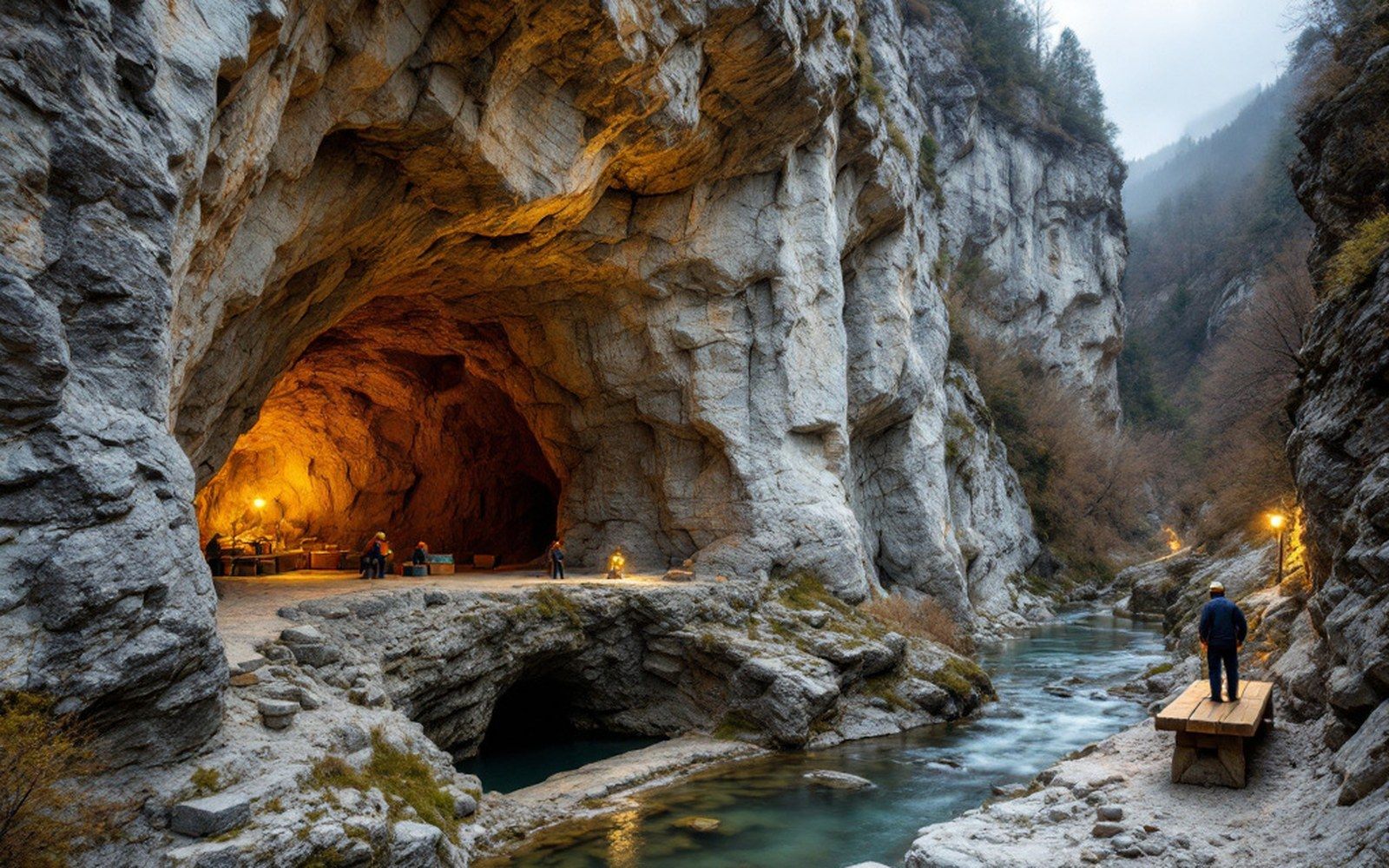
Schmerling was born in 1791 in Delft, and trained in medicine at Würzburg before settling in Liège, where he lectured at the university. It was geological curiosity, not an institutional mandate, that sent him into the caves. Beginning around 1829, he worked systematically through the limestone country of the Meuse basin, lowering himself on ropes into fissures, crawling through low passages with candles, and keeping notes on what he recovered and from which layer. The caves near Engis, in the commune of Engis in the province of Liège, were among his most productive sites: there he recovered animal bones — cave bear, rhinoceros, mammoth — alongside deliberately struck flints and, from a breccia layer that also held the extinct fauna, fragments of human skull.
The Engis skull fragments — including a well-preserved adult cranium and pieces of a child's cranium — came from a cemented deposit. Schmerling noted that the human material lay in the same horizon as bones of species no longer living in Europe, and he argued, carefully, that the association was genuine: these were not intrusive burials dug down from a higher level. That argument was stratigraphic — based on the physical relationships of the layers — and it was the right argument to make. Nobody in 1829 had the vocabulary to call the skull Neanderthal, because the Neander valley specimen was not found until 1856 and not named until 1864. The full story of that skull's belated recognition stretches across more than a century.
Chronology
- c. 1829Schmerling begins systematic cave exploration in the Meuse limestone belt
- 1833–1834Recherches sur les ossements fossiles published in two volumes, Liège
- 1833Lyell visits Engis, examines the collections, remains sceptical
- 1836Schmerling dies
- 1856Neander valley specimen found; 1864 formally named Homo neanderthalensis
- 1863Lyell publishes The Geological Evidence of the Antiquity of Man, accepting antiquity of humanity
- Late 20th centurydirect radiocarbon dating applied to the Engis material
03What he published and what it claimed
In 1833–1834 Schmerling published Recherches sur les ossements fossiles découverts dans les cavernes de la province de Liège in two large quarto volumes, illustrated with lithographic plates. The work described the fauna in detail: cave hyena, cave bear, woolly rhinoceros, mammoth, horse, reindeer. It described the stratigraphy of each site, noted the position of human remains relative to the extinct fauna, and reproduced drawings of the flint tools recovered from the same deposits. The Recherches is a foundational text in European Quaternary science ↗, and its lithographic plates remain the primary published record of much of what Schmerling recovered.
The argument Schmerling made was cautious but clear: the human bones were contemporary with the extinct animals in the same breccia, which meant humans had lived in this part of Europe at a time when mammoth and woolly rhinoceros were still present. This was a claim about deep antiquity. In 1833, orthodox opinion — academic and ecclesiastical — held that human history was bounded by the Biblical chronology; the idea of a humanity contemporaneous with extinct Pleistocene megafauna was not merely novel but unsettling. Schmerling was not writing polemic. He presented layers, positions and faunal lists, and let the association make the case.
The work described the fauna in detail: cave hyena, cave bear, woolly rhinoceros, mammoth, horse, reindeer.
His reception was cool. The English geologist Charles Lyell visited Engis in 1833, examined the site and the collections, and noted the association — then declined, for many years, to accept the human bones as genuinely contemporary with the fauna. Lyell would only revise that position, publicly and in print, in 1863 in The Geological Evidence of the Antiquity of Man, by which point Jacques Boucher de Perthes had fought a long battle over the Somme gravels and John Frere's earlier observations at Hoxne had been retrieved from obscurity. Schmerling had been dead since 1836.
What the layers showed
04The flint question
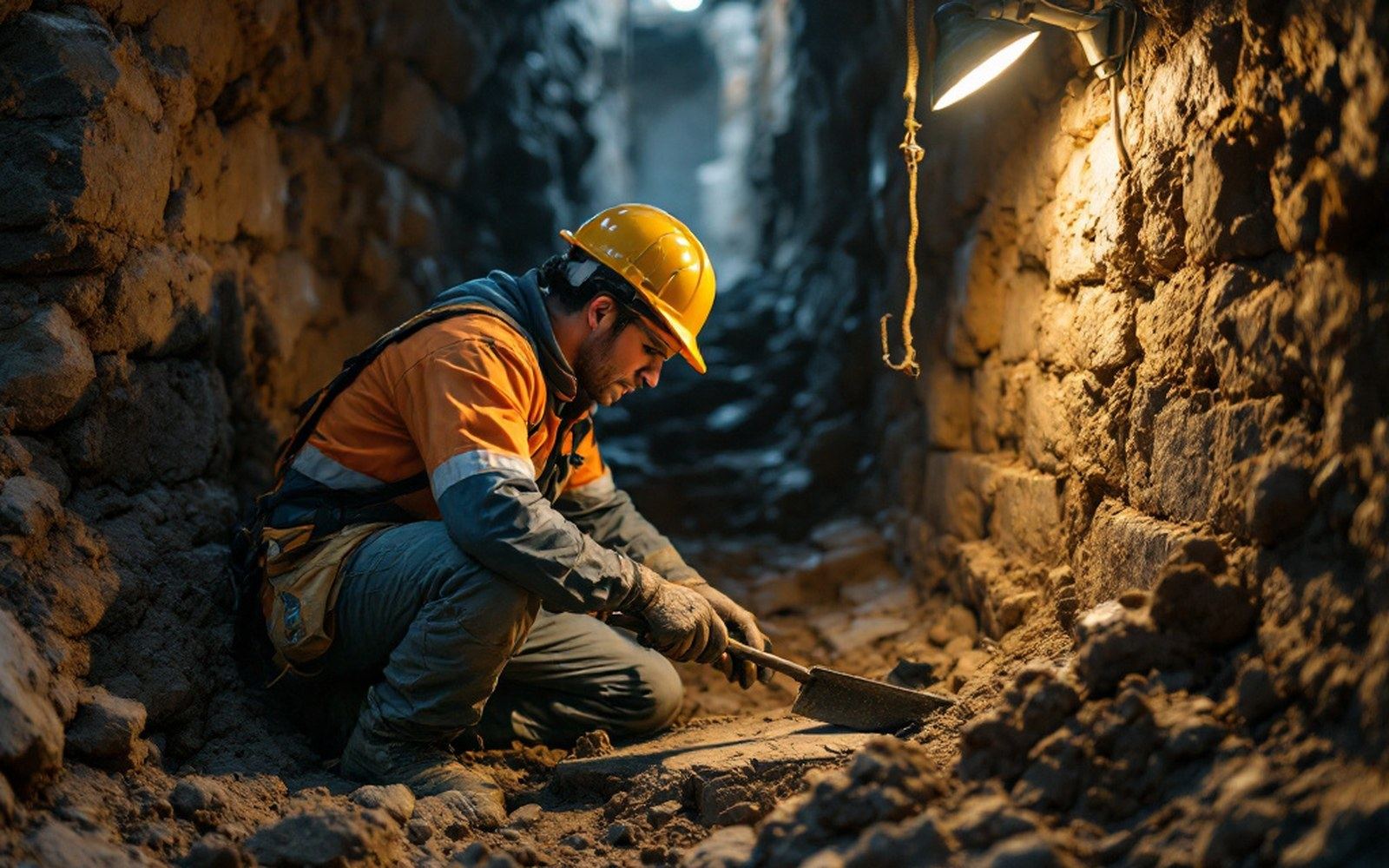
The lithic material Schmerling recovered from the cave deposits has been discussed and debated ever since. He recognised that certain flints from the Meuse caves were not natural fractures but intentional products: they showed platform preparation, controlled angles of percussion and deliberate edge morphology. He illustrated them. Whether those pieces represent Mousterian industry — the flake-dominated technology associated with Neanderthals — or include material from later Upper Palaeolithic episodes is a question that has occupied subsequent excavators and analysts, because Schmerling's recovery methods, however good for 1829, did not produce the kind of granular stratigraphic record that later work demands. The principles behind reading a worked flake's production were not formalised until Levallois technology was defined later in the nineteenth century; Schmerling was working without those categories.
05What he established and what he could not know
Four things stand firm. First, Schmerling documented genuine stratigraphic association between human remains and extinct Pleistocene fauna in the Meuse limestone caves. Second, he recognised deliberately worked flints in those same deposits. Third, he published a coherent, illustrated, detailed account — not a collection of anecdotes — at a time when systematic cave excavation barely existed as a discipline. Fourth, the Engis child's cranium he recovered is, on current understanding ↗, among the earliest Neanderthal fossils found anywhere, even though neither he nor anyone else could recognise it as such until decades of subsequent excavation and anatomical analysis had built the comparative framework.
What he could not do was interpret his material against a theory of human evolution, because no such theory had been published. He could not use radiocarbon dating, which would not exist for another century. He could not apply the typological systems — Mousterian, Aurignacian, Gravettian — that Édouard Lartet and Gabriel de Mortillet would work out in the 1860s and later. He worked with stratigraphy, careful observation and an honest description of what each layer contained. That is exactly what the discipline still rests on.
The Recherches is a foundational text in European Quaternary science, and its lithographic plates remain the primary published record of much of what Schmerling recovered.
The collections Schmerling amassed passed after his death to the University of Liège ↗, which held them through the subsequent century of reanalysis and direct dating. When researchers applied modern methods to the Engis material in the late twentieth century, they were working with specimens Schmerling had excavated, labelled and described almost a hundred and seventy years earlier. The labels were good enough that the specimens could still be traced to their sites and, in broad terms, to their layers. For 1829, that is a considerable achievement.
Read next