Section III · The Flint · Entry 02
Striking and Platform
Where you hit it and at what angle decides what comes off, and the scars left behind record the order of the blows.
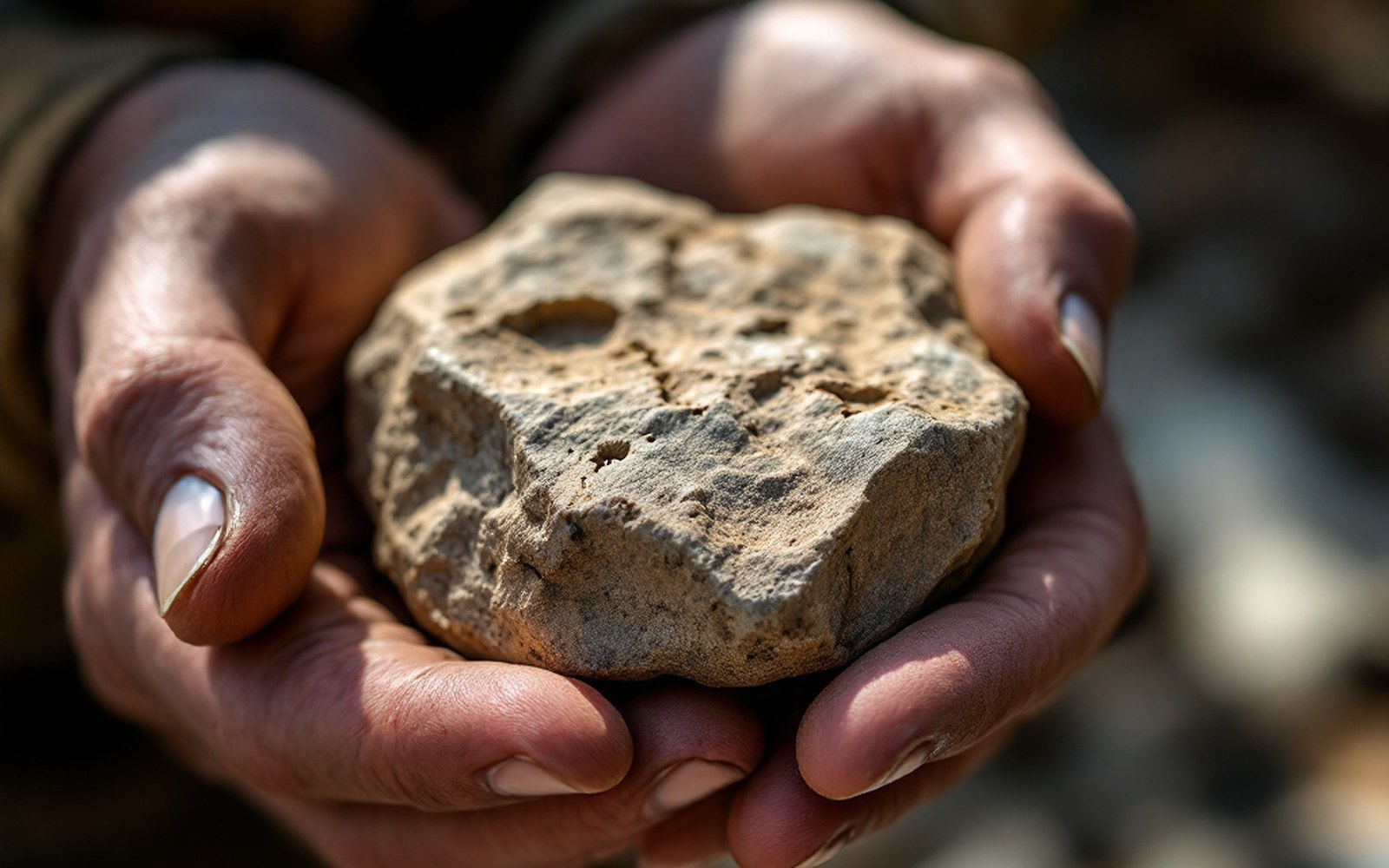
01The geometry of a blow
Every flake begins with a decision about where to hit the core and at what angle. The toolmaker strikes a prepared surface — the platform — with a hammerstone or antler billet, sending a cone of force through the flint that peels a flake from the face below. Change the platform angle by five degrees and you change the thickness of the flake. Change the position of the blow and you change its length. Nothing about the outcome is accidental once the knapper knows what they are doing, and almost nothing about it is invisible once a lithic analyst knows how to read the scar.
The platform itself is the flat or gently angled surface that the hammer meets. On an unprepared core it is simply the original edge of a nodule or the scar left by a previous blow. On a prepared core — the kind of systematic reduction documented at sites across the Meuse valley from the Middle Palaeolithic onward — the platform has been deliberately shaped. The knapper removes small preparation flakes around the rim, creating a faceted surface that guides the force and reduces the chance of the core shattering unpredictably. Faceted platforms are one of the clearest signatures of controlled, Levallois-style reduction: you can see the preparatory negatives surrounding the main striking point and read them as prior decisions.
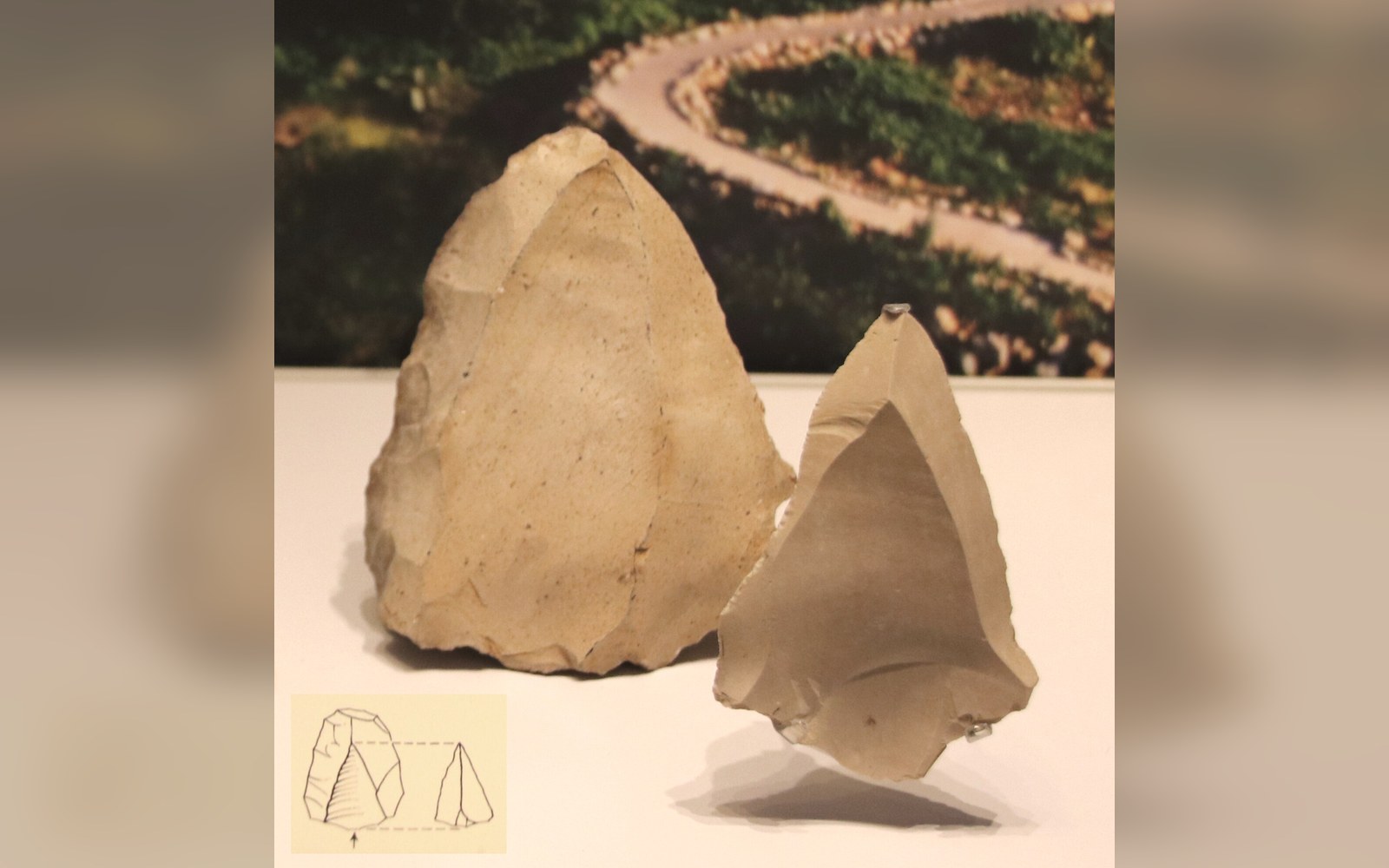
02What the scar records
When a flake detaches, it leaves a negative on the core and carries a positive on its own dorsal face. Both surfaces record information. The ripple marks that radiate from the point of percussion, the eraillure scar just below the bulb of percussion, the angle of the bulb itself — all of these are mechanical consequences of the blow, and all of them are diagnostic ↗. A hard-hammer blow leaves a pronounced, well-defined bulb; a soft-hammer blow in antler or dense wood leaves a shallower, more diffuse one and tends to produce longer, thinner flakes. The difference matters for reading assemblages: the presence of soft-hammer technique is one signal that production has moved toward the blade technology associated with the Upper Palaeolithic.
On the dorsal face of a flake, the scars of earlier removals record the sequence of prior blows. A flake detached early in a reduction sequence will show mostly cortex — the outer rind of the nodule — on its dorsal face. A flake detached later will show a mosaic of older scars crossing and partially obscuring each other. In principle, enough flakes from a single knapping episode can be fitted back together — refitted — to reconstruct the entire sequence of blows. Refitting studies carried out on assemblages from Belgian cave sites have confirmed reduction sequences that stratigraphic position alone could only imply, grounding the technology in observable physical evidence rather than inference.
How a flake forms — sequence
- Platformthe surface the hammer strikes; may be plain, prepared, or faceted
- Bulb of percussionthe dome that forms on the ventral face directly beneath the blow
- Ripple marksconcentric waves radiating outward from the percussion point; record force direction
- Eraillure scarsmall secondary scar just below the bulb; confirms point of impact
- Dorsal scarsnegatives of earlier removals; read in sequence to reconstruct reduction order
03Reading the platform angle
Platform angle — the angle between the platform surface and the flaking face — is measurable and recorded routinely in assemblage analysis. Angles between roughly 60 and 80 degrees are optimal for detaching a controlled flake; angles outside that range tend to produce either hinge fractures that terminate too soon or plunging removals that run off the base of the core. A collection of hinge-terminated flakes in an assemblage is diagnostic: it suggests a knapper working a core that had become difficult, or one that had not prepared the platform correctly before striking. It is not evidence of incompetence in any simple sense — even skilled knappers produce hinges — but a high proportion of them says something about the state of the core at that stage of reduction.
What makes platform and striking data useful archaeologically is that the measurements survive. The flint does not decay; the angles can be taken on material excavated in the nineteenth century as reliably as on a freshly dug assemblage. That is what allows researchers at institutions such as the Institut royal des Sciences naturelles de Belgique ↗ to revisit old collections from sites like Goyet or Spy and extract technological information that the original excavators did not know to record. The blow is long gone. The geometry it left behind is still there.
When a flake detaches, it leaves a negative on the core and carries a positive on its own dorsal face.
Key angles

Read next