Section I · The Caves · Entry 01
Engis
Schmerling excavated a fossil skull here in 1829 that was the first Neanderthal ever found, three decades before the Neander valley named the species and a century before anyone recognised what it was.
01A skull dug up before the idea of prehistoric man existed
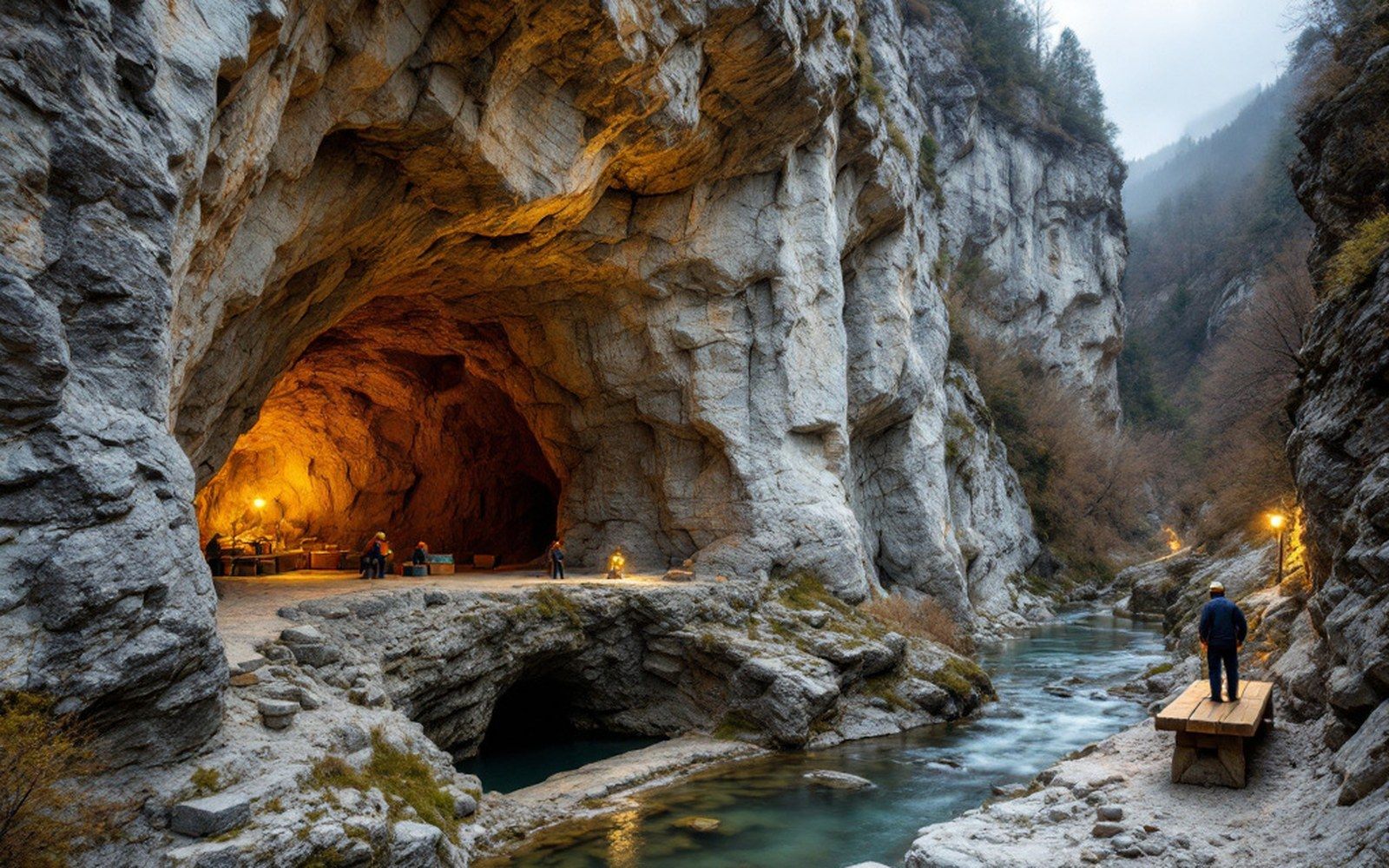
The cave at Engis ↗, in the commune of Engis, Liège province, sits in the limestone bluffs above the Meuse, a few kilometres downstream from Liège. In 1829, Philippe-Charles Schmerling began working the cave and extracted a human skull from deep within the cave deposits — a skull that would eventually be identified as Neanderthal, though that identification took more than a century to arrive. What Schmerling had in his hands was the earliest-found Neanderthal specimen in the historical record, pre-dating the Feldhofer cave find in Germany's Neander valley by nearly three decades. The discipline of palaeontology barely had the vocabulary to describe what he was looking at.
02What Schmerling found, and how
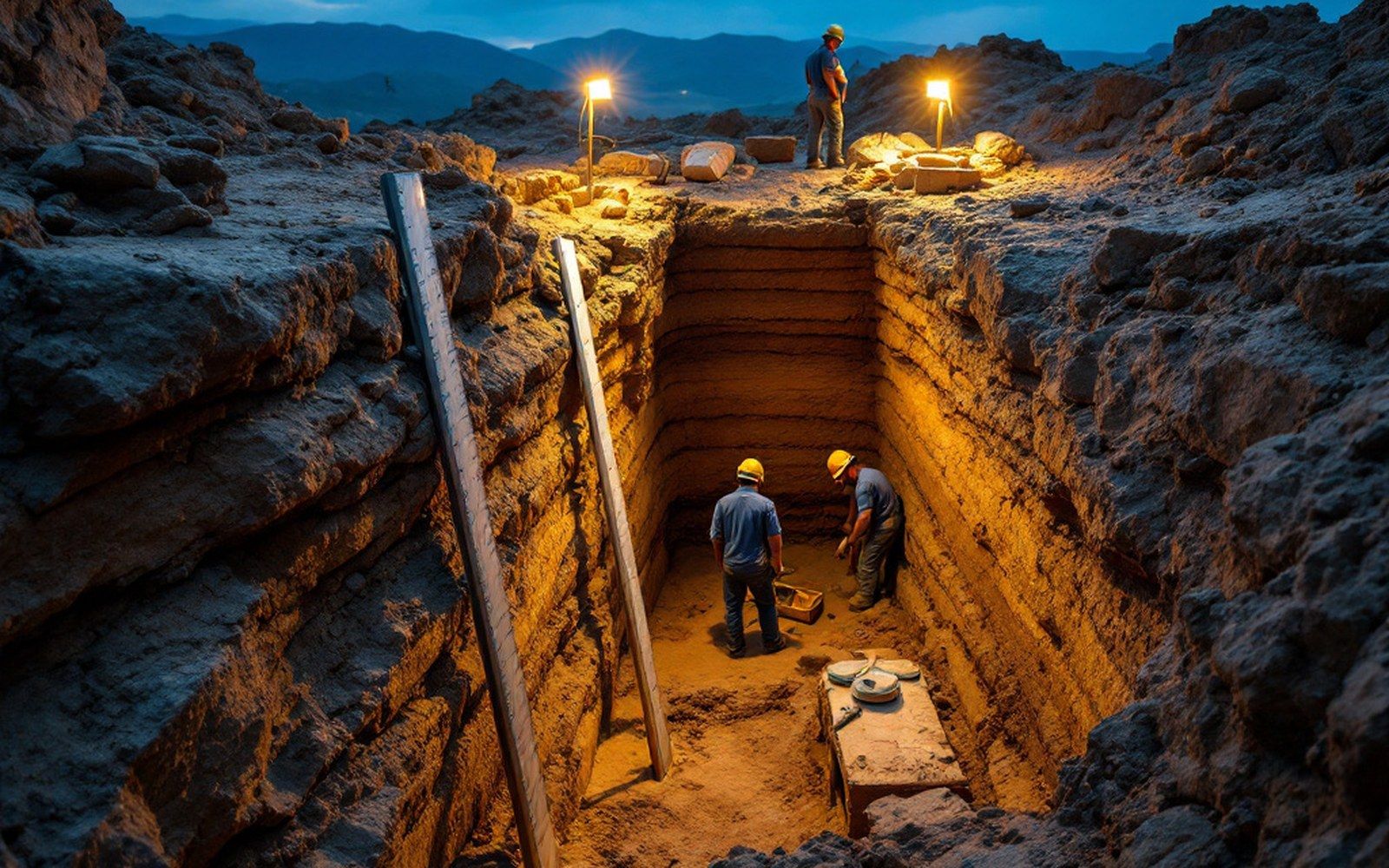
Schmerling was a physician and naturalist working under his own initiative, funding his excavations himself and working the Meuse valley caves systematically at a time when no institutional framework existed for such work. At Engis he found the skull — now designated Engis 2, to distinguish it from a second cranium recovered at the same site — buried in a layer alongside extinct animal bones: rhinoceros, mammoth, horse. The association was the point. Schmerling argued, correctly, that the human material and the extinct fauna were contemporaneous deposits, not intrusions. The stratigraphy was his evidence: the bones lay in the same compact, undisturbed cave loam, below intact roof spall, and he described the section carefully in his Recherches sur les ossemens fossiles découverts dans les cavernes de la Province de Liège, published in two volumes in 1833–34.
That argument — contemporaneity of humans and extinct megafauna — was the incendiary claim. The geological and theological consensus of the time held that humans could not pre-date the existing order of the world in any meaningful way, and most of Schmerling's contemporaries either ignored the conclusion or found reasons to reject the stratigraphy. Even Sir Charles Lyell, who examined Schmerling's collection in Liège, did not publicly endorse the antiquity of humans until the 1860s. Schmerling died in 1836 with his core finding unaccepted.
Chronology
- 1829Schmerling excavates Engis; extracts Engis 2 skull from cave loam with extinct fauna
- 1833–34Recherches sur les ossemens fossiles published; contemporaneity of humans and megafauna argued
- 1836Schmerling dies; the stratigraphic argument remains rejected
- 1856Feldhofer skullcap found; Neanderthal named as a category (retrospectively making Engis 2 the earlier find)
- 1886Spy excavation by De Puydt and Lohest gives Belgian anatomists a clean morphological reference
- Late 20th–21st centuryDirect radiocarbon dating of Engis 2 is attempted; the results are debated, partly over possible sample contamination
The Engis 2 skull itself is a partial calvaria — the upper dome of the braincase, minus the face. In 1829 there was no morphological benchmark for what a Neanderthal should look like, because the Neanderthal as a category did not yet exist. The skull was noted as ancient and associated with fauna, filed in the collections, and interpreted as a primitive modern human at various points across the nineteenth century. The Feldhofer skullcap, found in 1856 in the Neander valley near Düsseldorf and formally described by Hermann Schaaffhausen, created the type specimen and gave the species its name. But the Engis 2 skull was older in the drawer.
The Engis 2 skull itself is a partial calvaria — the upper dome of the braincase, minus the face.
03Recognition, revision, and what the bone actually shows
The anatomical reassessment of Engis 2 as Neanderthal did not come quickly. Through the later nineteenth century the Engis material was discussed periodically — it appeared in comparative literature as a reference point for ancient European skulls — but its Neanderthal status remained uncertain. The vault is not dramatically non-modern in the way the Feldhofer cap is: the browridge, the occipital torus, the interior volume all required systematic measurement against a comparative population that took decades to assemble.
It was Julien Fraipont ↗ at the University of Liège, already working on the Spy skeletons excavated in 1886, who brought rigour to Belgian Palaeolithic human anatomy. The Spy material — two well-preserved skeletons from a single stratigraphic layer — gave anatomists a clean Neanderthal reference in Belgium. Against that baseline, the Engis 2 skull's affinities became clearer, and the consensus attribution to Neanderthals was eventually secured through morphological comparison. The braincase volume is large, within the Neanderthal range; the posterior profile of the vault shows the characteristic bun-shaped occipital region. What Engis 2 does not preserve is the face, which is why the diagnostic supraorbital torus cannot be measured directly.
The two skulls
The second find from Engis, designated Engis 1, is a different matter entirely. It is anatomically modern — a Homo sapiens skull, found in the same general excavation area but from what is now understood to be a different and later context. Nineteenth-century excavation did not always resolve such distinctions in the section, and separating the two stratigraphic events at Engis took subsequent analysis rather than original field recording. The site thus illustrates a problem that runs through the entire early corpus of Belgian cave archaeology: rapid extraction without systematic layer-by-layer recording meant that spatial relationships in the deposit were often irretrievably lost.
04The flint assemblage and faunal context
The stone tools associated with the Mousterian deposits at Engis are characteristic of the Middle Palaeolithic technology found across Belgian cave sites of comparable age: side-scrapers, points and some Levallois-prepared flakes, all in local flint. The Levallois method — in which the core is shaped by a prepared platform before the intended flake is detached — is recognisable in the Engis material, though the assemblage was never separated by sub-layer in Schmerling's time, which limits fine-grained technological analysis. The fauna Schmerling recorded — woolly rhinoceros, mammoth, cave bear, horse — places the deposit in a cold-stage environment consistent with the broadly Middle Palaeolithic record of the Meuse basin, though how direct radiocarbon dates on the skull itself should be read is still debated.
The cave's physical situation also matters. Engis sits in the heavily quarried and industrialised Meuse gorge below Liège, and the limestone country in this reach of the valley has been substantially altered since the nineteenth century. The cave's stratigraphy as Schmerling recorded it no longer exists in explorable form; what survives is the published section description and the collected bone, now held in Belgian institutional collections. Direct dating of museum-held Neanderthal specimens from this era has transformed the understanding of comparable Belgian sites, and Engis 2 has been subject to that scrutiny: the skull has been directly radiocarbon dated, but the reliability of the results is debated, and it should be treated as a Neanderthal specimen from the region whose exact age remains uncertain.
In 1829 there was no morphological benchmark for what a Neanderthal should look like, because the Neanderthal as a category did not yet exist.
What the site amounts to, in the end, is an epistemological record as much as an archaeological one: a bone found before the concept existed to receive it, described by a man whose conclusion was correct and whose evidence was real, ignored for a generation, and then slowly absorbed into a framework that had to be built from scratch around finds exactly like this one.
Read next