Section II · Stratigraphy · Entry 01
Depth is time
The principle the whole discipline rests on: what is lower was deposited earlier, unless something disturbed it.
01The one rule that holds almost everything else up
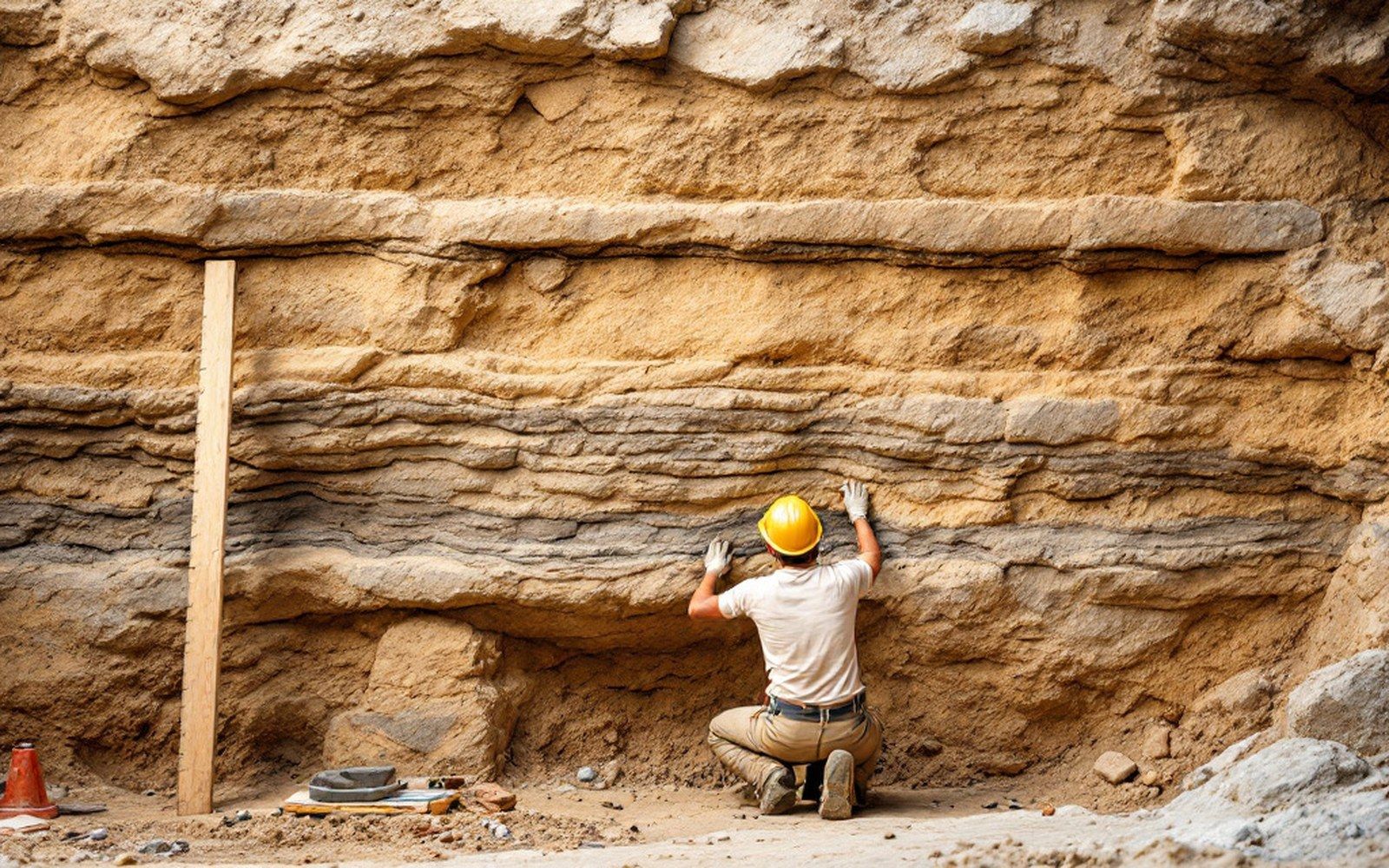
Stratigraphy is the reading of layers — the proposition that, in an undisturbed deposit, what lies deeper was laid down earlier. It sounds obvious, and that is precisely why it took so long to take seriously. For most of the eighteenth century, the contents of caves were treated as a single undifferentiated mass: bones, flint, silt, all shovelled out together, their relative positions unrecorded and therefore unrecoverable. The depth-is-time principle was not a discovery so much as a discipline, and the difference between excavators who applied it and those who did not is legible in the quality of everything that followed.
Cave sediment accumulates slowly and by several mechanisms at once. Silt washes in from outside when water moves through the cave. Roof fragments — angular blocks and fine particles both — fall onto the floor as limestone dissolves and the rock overhead weakens. Material blown or carried in by animals or hominins settles on whatever surface exists at that moment. Each episode of accumulation buries the one before it. Under ideal conditions, the result is a layered sequence: a stratigraphic column that can be read, from bottom to top, as a record of time. What was on the floor during one climate episode is sealed beneath what accumulated during the next. The cave loam and the limestone floor that recurs in so many Meuse basin sites is exactly this: fine-grained washed-in sediment overlying bedrock, itself overlain by successive fills that post-date it.
02What disturbs the record — and how you know
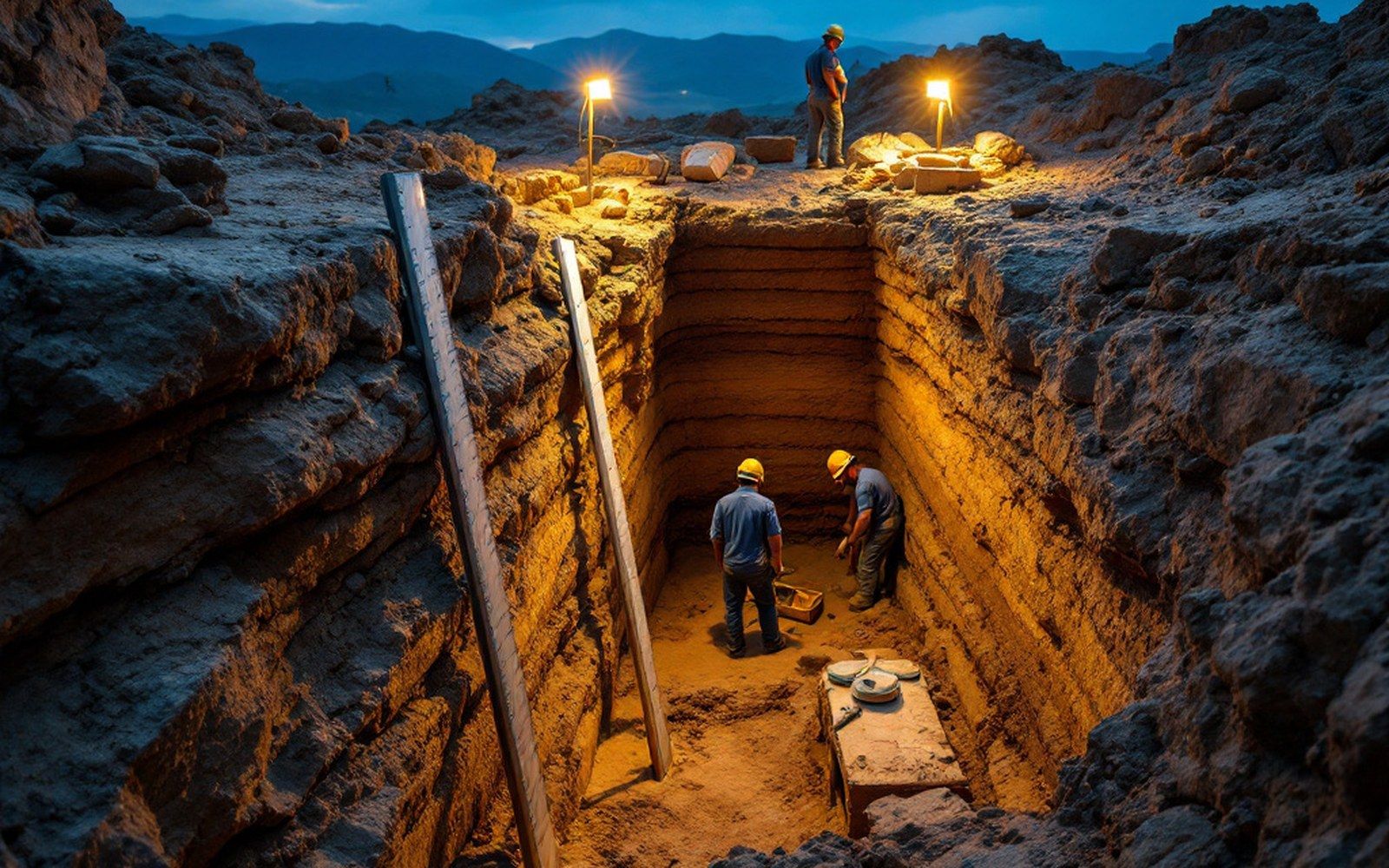
The rule holds unless something broke it, and the candid answer is that something often did. Water does not only deposit; it also scours, re-sorting material and carrying lighter objects horizontally or downslope. Animals burrow, dragging bones and sometimes flint nodules through several centimetres of previously stable fill. Earlier excavators, working without stratigraphic intent, opened trenches that later investigators then dug into without always recognising the disturbance. And hominins themselves, during occupation, dug pits, built hearths into older surfaces and displaced material that was already there.
The detective work is in the section — the exposed vertical face of a trench. A clean section shows layers as bands: their colour, their texture, their grain size, the inclination of their contact surfaces. A disturbed deposit announces itself: a lens of one material sitting at an improbable angle inside another, a layer that cuts across the ones it should run parallel to, a concentration of bones with no anatomical logic in a matrix that is otherwise sterile. These are not always easy to read, and even skilled excavators have disagreed about what a section shows. But without the section, the question cannot even be asked. A site where no stratigraphic record survives — where only the objects and their catalogue numbers remain — can only be dated by the objects themselves, which is circular and insufficient.
The stratigraphic column — how the sequence works
- Figure: the stratigraphic column of a generic cave section, withbedrock at the base and successive fill layers numbered from bottom to top, their colour and texture varying from one to the next. Contact surfaces between layers are labelled, and the places where a disturbance such as burrowing or an old trench might appear are marked.
The Meuse basin sites make the contrast vivid. Philippe-Charles Schmerling excavated in the caves around Engis, Liège, in the 1820s and 1830s with genuine attention to where things lay, noting which bones came from which level and recording their association with extinct fauna. What he could not do was translate those observations into a formal stratigraphic sequence with named and numbered layers. His records were good for their time and are still cited, but they are not good enough to resolve the questions that radiocarbon dating later forced on the material. At Spy, Jemeppe-sur-Sambre, by contrast, Marcel De Puydt and Max Lohest in 1886 recorded layer by layer, noted the horizontal position of each significant find within its layer and drew the section. Because that record survived, direct dating of the Spy skeletal material a century later could be related back to a stratigraphic context rather than having to stand alone.
The detective work is in the section — the exposed vertical face of a trench.
03Radiocarbon and what it needs from a layer
Modern radiocarbon dating ↗ measures the decay of carbon-14 in organic material — bone, charcoal, shell — and returns a date that expresses the elapsed time since the organism died. The technique is powerful, and its precision has improved steadily since Willard Libby's initial calibration work in the late 1940s. But a radiocarbon date is only as reliable as its stratigraphic context. A bone that has been displaced from its original layer — by water, animal action or an old excavation — will return a date, but that date will describe the animal's death, not the layer it was found in. The two facts may not be the same. Only when you know, from a clean stratigraphic record, that the bone genuinely belongs to the horizon you think it does can you use the date to characterise that horizon.
This is why revised attributions matter so much in this region. Material excavated in the nineteenth century and assigned, on typological grounds, to a particular industrial phase has sometimes been redated by direct radiocarbon measurement and found to belong to a different period entirely. The revised attributions that have accumulated across Belgian Palaeolithic sites are not failures of the original excavators; they are the predictable outcome of applying techniques that did not exist at the time to deposits whose stratigraphic integrity is not always recoverable. The layer is the anchor. Without it, the date floats.
Key principle and its limit
04What the Meuse basin teaches about reading section
The limestone plateau that the Meuse and Lesse valleys cut through offered caves to every occupation phase from the Middle Palaeolithic onward. The same caves were used repeatedly, because the landscape invited it. At Goyet, Gesves, Édouard Dupont dug in the 1860s at a scale and pace that was extraordinary even by the standards of the time: vast quantities of bone and flint emerged, but the stratigraphic control was uneven, and reassessment of the Goyet material using modern methods has had to work around that. At Furfooz, Dinant, where Dupont also worked, the challenge is similar: good animal bone assemblages, good lithic material, but sections whose precise character was not always recorded in a way that modern analysts can use without reservation.
The principle that modern disturbance matters — that quarrying, earlier digging and burrowing all move material and that reading a section means accounting for all of them — is not a complication added onto stratigraphy. It is stratigraphy. The discipline does not assume that every deposit is intact. It assumes that every deposit has a history, and that part of the excavator's job is to work out what that history was before drawing conclusions about what the layer contains and when it was formed. Depth is time, yes — but only if nothing changed that relationship, and demonstrating that nothing did is itself the work. Stratigraphic integrity is what gives a radiocarbon date its authority, and it is what separates a site that can answer questions from one that cannot — however rich its finds may be.
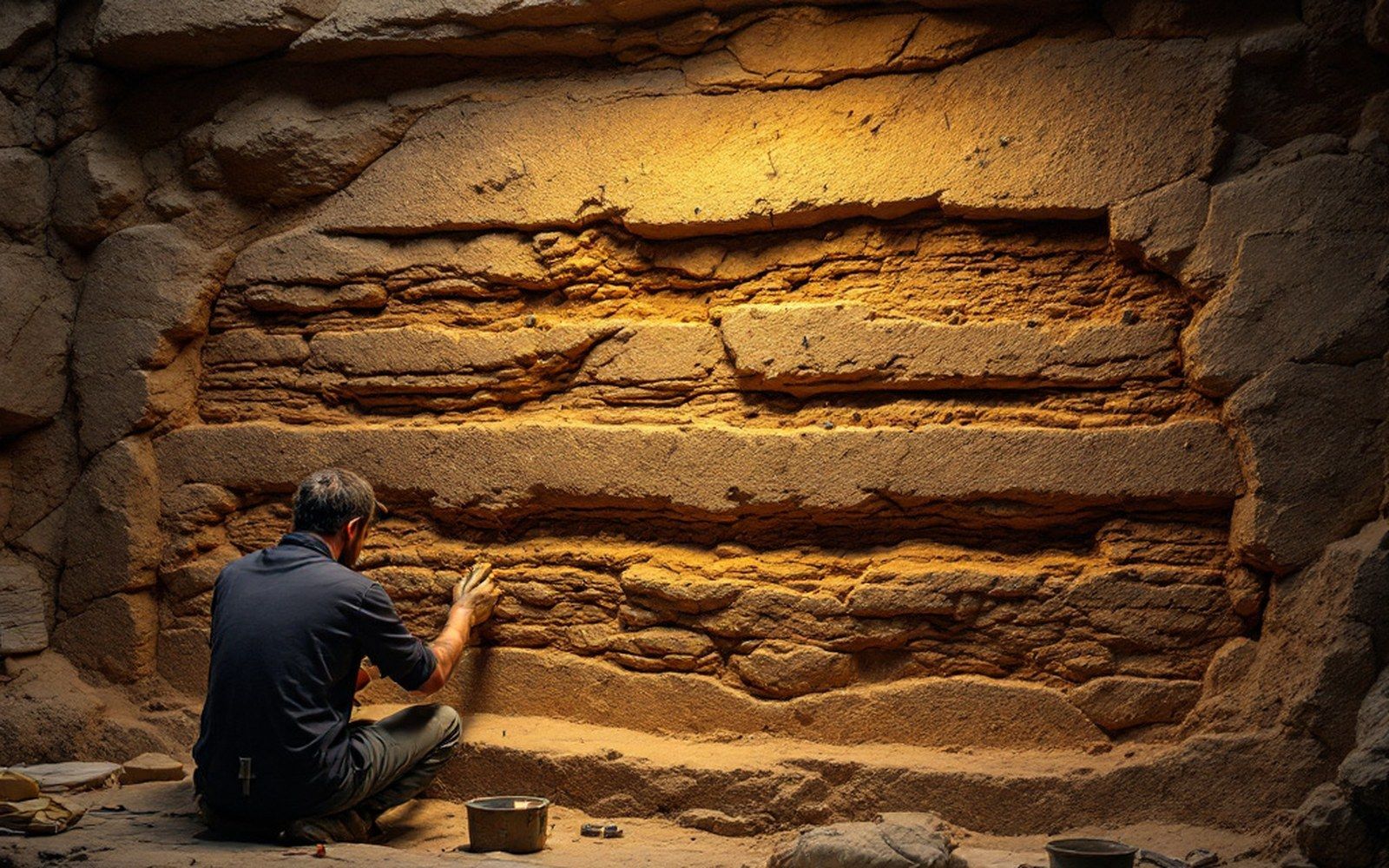
A clean section shows layers as bands: their colour, their texture, their grain size, the inclination of their contact surfaces.
Read next