Section V · The Excavators · Entry 03
De Puydt and Lohest
Two amateurs with a notebook changed the field by doing something almost nobody had bothered to do before: writing down exactly where each find came from.
At Spy in 1886 they recorded the layer each find came from, which is why their excavation settled an argument that earlier ones could not.

01The excavators and their moment
Marcel De Puydt was a lawyer and antiquarian; Max Lohest was a geologist. Neither held a university post in prehistory, and in 1886 neither needed one. What Lohest brought from geology was the habit of reading a section — the vertical face of an excavation — as a sequence of distinct layers, each deposited at a different time. That habit, applied to a cave fill at Spy, Jemeppe-sur-Sambre in the summer of 1886, produced results that reverberate through the discipline to this day.
The Meuse basin was already riddled with excavated caves. Philippe-Charles Schmerling had worked the Engis shelters in the 1820s and 1830s, recovering a child's skull that was, in retrospect, the first Neanderthal cranium ever lifted from the ground. Édouard Dupont had cleared sites through the Lesse valley from the 1860s onward, shifting sediment at a pace that left the stratigraphic record approximate at best. The problem was not lack of material. It was lack of context. Bones came out labelled by site, occasionally by depth, almost never by layer. When sceptics argued that the ancient-looking skulls were simply modern humans buried into older deposits, no one had the documentation to refute them cleanly.
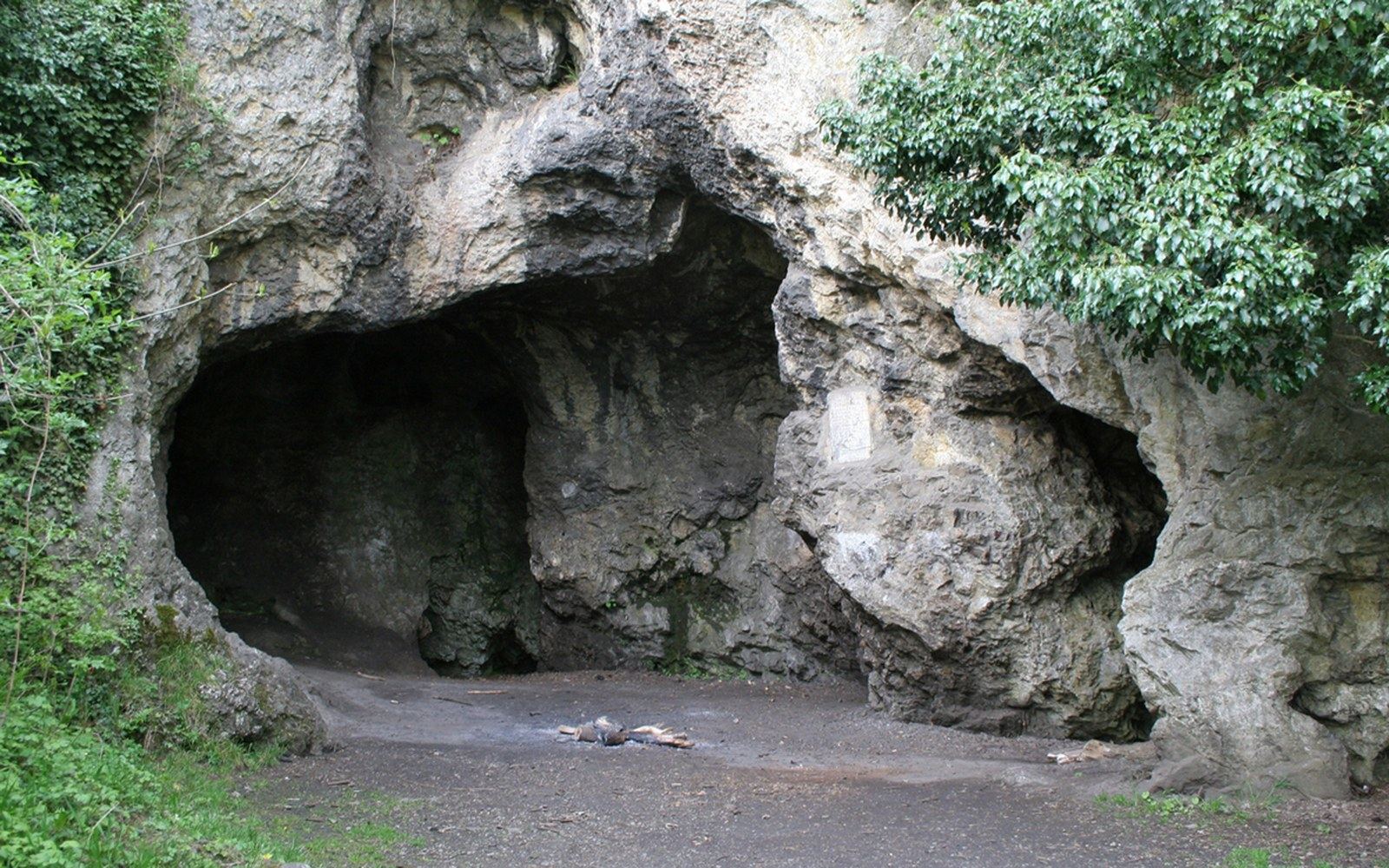
De Puydt and Lohest changed that at Spy because they recorded the stratigraphy — the sequence of sedimentary layers in the cave fill — and noted which layer each human bone, each stone tool and each animal bone came from. It sounds elementary; in 1886, across most cave excavation, it was not standard practice.
The 1887 publication
02What the section at Spy showed
The cave of Spy sits in the valley side at the commune of Jemeppe-sur-Sambre, Namur. The fill they encountered was not a single mass of sediment but a legible sequence. Near the top, a disturbed and relatively recent layer. Below it, an undisturbed stratum containing Palaeolithic fauna — the bones of reindeer, rhinoceros, mammoth and cave hyena — alongside Mousterian flint tools of the type characterised by carefully shaped points and scrapers. It was in this same undisturbed layer, not above it and not below it, that the two human skeletons came to light.
That co-occurrence was the argument. The bones were not intrusive burials cut from a later horizon into an older one; the sediment sealed around them was the same sediment sealed around the extinct fauna and the Middle Palaeolithic tools. All three categories of find shared a single depositional context, and De Puydt and Lohest had the notes to prove it.
The cave of Spy sits in the valley side at the commune of Jemeppe-sur-Sambre, Namur.
The anatomist Julien Fraipont ↗ of the University of Liège took on the skeletal description. His analysis, published with De Puydt and Lohest in a memoir to the Académie royale de Belgique in 1887, established that the Spy individuals displayed features — pronounced brow ridges, a long low cranial vault, a particular form of the occiput — consistent with the Neanderthal type described from the Neander valley in Germany in 1856. The Spy paper was not the first claim of a Neanderthal; it was the first claim that could not easily be dismissed, because the stratigraphic record made an alternative explanation genuinely difficult to sustain. Where earlier discoveries invited the charge that fossil-looking bones might have migrated downward through disturbed deposits, the Spy documentation showed an undisturbed layer. That is why the 1886 excavation settled an argument the earlier ones could not.
Chronology of the argument
- 1820s–30sSchmerling at Engis: first Neanderthal skull, no stratigraphic documentation sufficient to settle the debate
- 1856Neander valley, Germany: type specimen named; sceptics claim modern human pathology
- 1886De Puydt and Lohest excavate Spy: undisturbed layer links human remains, Mousterian tools and Pleistocene fauna
- 1887Fraipont's anatomical description published with the stratigraphic record
- Post-1990sdirect radiocarbon dating of Spy bones revises chronology; provenance documentation makes this possible
03Technique and its limits
To call De Puydt and Lohest methodologically modern would be an overstatement. The excavation was rapid by later standards, covering substantial area in a single season. Small finds — fragments of worked flint, fragments of bone — may not have received individually recorded positions in the sense a twentieth-century excavation would require. What they did do was distinguish layers, assign major finds to those layers, and publish their section drawing alongside the faunal and skeletal reports. That triptych — section, fauna, human remains — cross-referenced through the text, gave the 1887 memoir its force.
The Levallois component of the Spy assemblage — the flaked cores and the characteristic flakes struck from a pre-shaped surface — was also noted in the tool descriptions, adding technological specificity to the stratigraphic argument. The Mousterian and Levallois material placed the site squarely within the Middle Palaeolithic industrial tradition; the fauna confirmed a cold-period environment; and the human skeletons sat in that same cold-period Middle Palaeolithic layer.
Who did what at Spy
Lohest's geological training is visible in the care given to the section itself. His professional formation had taught him that sediment is not neutral packing material but a record: grain size, colour, inclusion type and boundary character all carry information. Applied to a cave deposit, that reading gave the Spy section a legibility that contemporary cave excavations elsewhere often lacked. It is worth observing that Max Lohest went on to a distinguished career in geology entirely separate from his Spy work; the 1886 excavation was, for him, an application of skills developed for another purpose. De Puydt, coming from law and antiquarianism, supplied the organisational framework and the impetus to publish.
04After 1887
The subsequent history of the Spy material illustrates exactly why stratigraphic documentation matters beyond its first use. Direct radiocarbon dating of the Spy skeletal material, conducted many decades after the excavation, has repeatedly revised the chronological estimate. These studies could work at all because the provenance of the bones — the specific layer at the specific site — was never in serious doubt. Material dug without layer records offers no such anchor; it can be dated physically but the date floats free of any cultural or environmental context. De Puydt and Lohest inadvertently future-proofed the Spy collection for analytical methods that would not exist for another century.
The 1887 publication also established a template. Reporting a cave excavation thereafter required, at minimum, a section drawing and a layer-by-layer account of the finds. That the standard was not universally adopted immediately — Dupont's earlier Lesse valley work was already done, and its records were what they were — does not diminish what Spy demonstrated was possible. The argument that archaic-looking humans were contemporaneous with extinct Pleistocene fauna, and that the two had shared a world with a recognisably distinct stone-tool tradition ↗, was placed on defensible evidential ground in 1886 by a lawyer, a geologist and a careful set of field notes.
The fill they encountered was not a single mass of sediment but a legible sequence.
Read next